
Osprey Translocation Project – Schools IN for Summer

Posted on: July 12th, 2017 by Birds of Poole Harbour

Ospreys, also known as Mullet Hawks because of their exclusive fish-eating habits once bred all across Western Europe, including southern Britain but were sadly persecuted to extinction, with the last known historic breeding attempt occurring on the Somerset Levels in 1847.

Project Background

Osprey are one of the UK’s largest birds of prey and specialise their diet entirely on fish. Seeing one catch a large fish from the surface of the water is a truly impressive spectacle. They were once widespread across Western Europe, but due to persecution and habitat destruction were almost wiped out from everywhere but they managed to re-establish a tiny population in Scotland in 1954. In the late 1990’s a pioneering project led by the Roy Dennis Wildlife Foundation re-established a breeding population of osprey at Rutland Water in the Midlands; a big coup for osprey conservation.

Local charity Birds of Poole Harbour are now working with the Roy Dennis Wildlife Foundation and local tech company Wildlife Windows to use the same methodology, translocation, to re-establish breeding osprey to the south coast of the UK, which will provide an important link up to birds breeding on the continent, central and northern England and Scotland.

What is Translocation?

Translocation is a commonly used method in wildlife conservation, involving moving individuals from a healthy, sustainable population to another suitable location with the goal to create another healthy population. For this project, chicks are collected under licence from Scottish breeding pairs and brought down to Poole. The chicks which remain completely wild and have no human interaction are acclimatised to the area in pens for 2-3 weeks before being released into the harbour, where they spend a further couple of weeks imprinting on the area (memorising it as ‘home’) before they migrate off to West Africa for two years prior to returning to breed for the first time.

The Story So Far

The project began in the summer of 2017 when eight Osprey were raised and released into Poole Harbour by the team. Incredibly, they received news this winter that two of them had been spotted in Western Senegal and one in the Gambia, Africa. In slightly less excellent news, it seems that one hade maybe been predated by a crocodile! Mortality is usually high in young osprey as their first migrations are full of danger, so losses are to be expected and is the reason why a total of 60 chicks will be released over the five-year project.

Each spring and autumn Poole Harbour sees good numbers of migrant Osprey passing through the area as they make their way back and forth between their breeding ground. Excitingly, it seems that the presence of the Osprey chicks in the harbour has encouraged osprey from other populations to stick around and check out the area as well. Last year, a two-year old female from Rutland, CJ7, fed and roosted with the Poole chicks at their release site for a week. This year on her spring migration up from Africa, she came straight back to the harbour where she was seen investigating several of the nesting platforms put up around the harbour in a previous effort to encourage osprey to breed. It’s hoped that next spring, she may arrive back at the same time as the Poole birds and begin thinking about setting up a territory around the harbour somewhere.

This Season

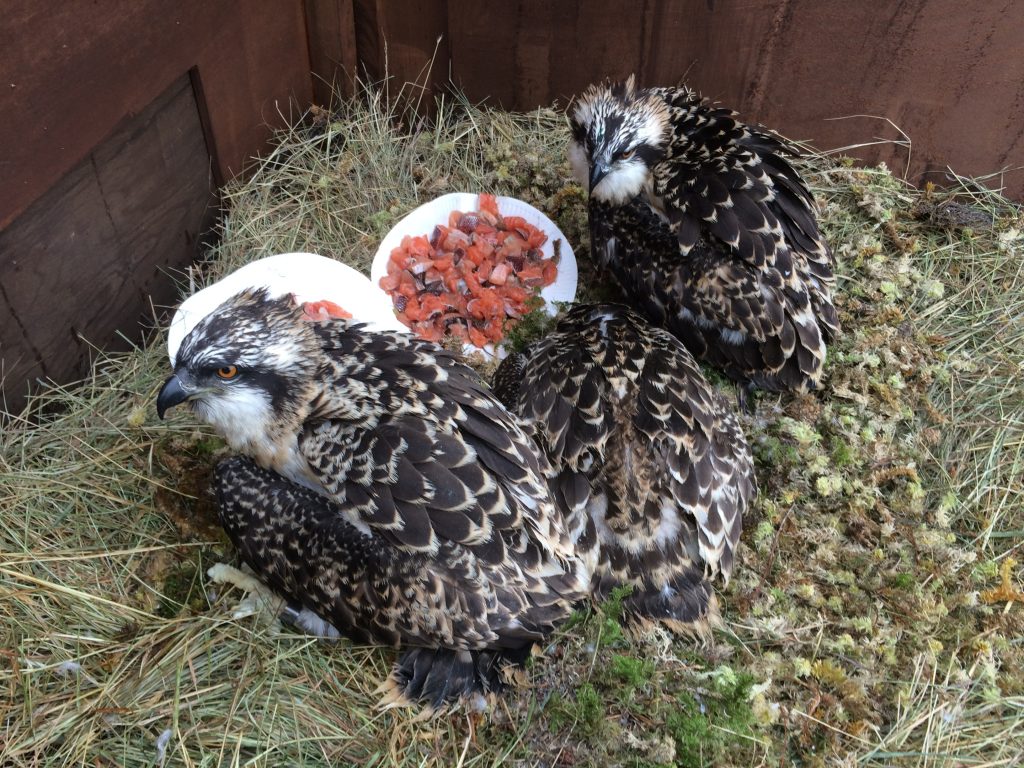
While the team wait with bated breath to see if any of the 2017 chicks return in the spring of 2019, the team are gearing up for a bumper release this year due to the arrival of the fourteen new chicks with the release scheduled for August. Each of the fourteen newly arrived birds has a unique numbered leg ring, which for this year will be 001 – 014. Whilst in the pens the birds will be fed by a small team of dedicated volunteers three times a day on freshly cut fish which for a second year in a row has been kindly donated to the project by Poole based fresh fish supplier Seafresh.

Paul Morton, co-founder of the Birds of Poole Harbour charity stated: I can’t believe we’re in the second year of the project already, it only feels like yesterday we were putting the application together. We’ve already successfully raised and released eight chicks last year and to have another fourteen this summer is really exciting. The project has had so much nationwide support and we can’t thank everyone enough for their kind words.

There is currently a life-size osprey nest, built by Jason Fathers of Wildlife Windows, on display in the Birds of Poole Harbour HQ on Poole Quay for visitors to see, and this nest will go out into the harbour to be used by the birds later this season. Due to popular demand, the team have also put on a number of Osprey cruises this August so that they can speak to the public about the project whilst cruising around the pristine setting of Poole Harbour and perhaps seeing an Osprey or two.
The (Fish) Eagle Has Landed – Osprey Chicks Arrive in Poole Harbour

Posted on: July 6th, 2017 by Birds of Poole Harbour

The chicks, which were collected from healthy, sustainable populations in northern Scotland were transported down in mid-July and are now settling into their new homes whilst familiarising themselves with the local area. The project which is being run by local charity ‘Birds of Poole Harbour’, Scottish charity ‘The Roy Dennis Wildlife Foundation’ and local wildlife technology company ‘Wildlife Windows’ was given the go-ahead this spring and it’s hoped that over the next 4-5 years Ospreys will adopt Poole Harbour as their new home and re-colonise the south coast.

Osprey were once widespread across the whole of western Europe but became extinct in the UK by the mid-1800’s mainly due to human interference and as a result struggled to recover across this region. The five-year project will see Osprey chicks being brought down to Poole Harbour each July and then held in large holding pens for two-three weeks, before then being released as soon as they are able to fly. It is during their first few weeks on the wing that Poole Harbour becomes imprinted as home rather than Scotland. Male Ospreys normally return to their natal areas to breed, and so it is hoped that males will start to look at setting up territories on the south coast by 2021.

Osprey pass through Poole Harbour every year on migration, attracted by the abundance of fish such as Mullet and flatfish. In late August the harbour can host up to 6 Osprey at any one time as birds fatten up before their long migration down to west Africa.

As Osprey feed exclusively on fish, a vital part of the project is ensuring that the newly arrived chicks get enough fresh food to fatten themselves up before being released in early august. The project team have linked up with Poole based fish restaurant ‘Storm’ who have kindly offered to source, prepare and store the fish for the chicks to help support the project. The prepped fish will then be fed to the chicks by a small team of volunteers through July and into August where their health and behaviour will be closely monitored.

Paul Morton from the ‘Birds of Poole Harbour’ charity stated:

“We’re so pleased to see the chicks finally arrive in Poole Harbour. It’s been a long few months waiting for this moment, so to see them in the pens has made the whole project very real now. The public support we’ve received has been over-whelming and the offer of help from ‘Storm’ restaurant has been key to making this part of the process run smoothly and efficiently”

Pete Miles, owner of ‘Storm’ restaurant and local fisherman added:

“It’s a real privilege to be involved in the project and to help the Osprey team out. Anything that helps promote and educate local environmental stories is always good news. We’ve already got all the facilities to prep fresh fish, so it made sense to offer help, plus I’m really looking forward to seeing these birds out flying around the harbour in years to come whilst I’m out on my fishing boat.”

The chicks were carefully monitored and collected by Roy Dennis and Tim Mackrill from the “Roy Dennis Wildlife Foundation”, whose decades worth of experience in Osprey conservation and biology ensured the young chicks were in the best hands possible. Roy has monitored Osprey nests in Scotland since the 1960s and was able to select the healthiest chicks from pre-chosen nests.

Roy Dennis stated:

“We are delighted that this exciting and important project is underway. Establishing a population of Ospreys on the south coast will restore the species to an area where it was once common and also help to link expanding populations in central England, Wales and northern France.  We are moving the birds to the best possible location given the abundance of fish found in Poole Harbour and the plethora of potential nest sites in the surrounding area. I’m particularly excited about this project because I was born in the New Forest.”

Once the chicks look ready and strong enough to fly, the Osprey monitoring team will open the pens, allowing the chicks to take to the wing for the first time and explore their new area. It is expected that the young Ospreys will remain in the harbour for a further 4-6 weeks after release before they begin their long migration to West Africa. The released Osprey will then remain in Africa during the summer and winter of 2018 and won’t think about flying north to the UK until late spring 2019. Its hoped that the first breeding will take place around 2021.

Poole Harbour Osprey Translocation Project to Start This Summer

Posted on: June 20th, 2017 by Birds of Poole Harbour

A new and exciting Osprey translocation has been given the go ahead to take place in Poole Harbour this year as a first stage in establishing a south coast breeding population of this spectacular bird. The project is being led by local charity ‘Birds of Poole Harbour’, Scottish charity the ‘The Roy Dennis Wildlife Foundation’ and local Poole-based business ‘Wildlife Windows’.

Ospreys, which feed exclusively on fish, historically bred across the whole of Britain and NW Europe; but populations drastically declined in the Middle Ages and became extinct in England by the mid 1800’s. The five-year project looks to restore Ospreys to their former breeding grounds in the south of England where they used to have the local nickname “Mullet Hawk”. At the same time the project will provide an important stepping stone between breeding populations in Britain and northern France, with the aim of enhancing the long-term survival of the Western European population as a whole. The project is part of a wider conservation recovery plan of Osprey in Western Europe and the Mediterranean region.

A Conservation Recovery Plan

Ospreys are annual visitors to Poole Harbour as they pass through on their northward and southward migrations between their breeding grounds in Scotland and central England and their over-wintering grounds in West Africa. Over the last 8 years, efforts within Poole Harbour have been made by the RSPB, Natural England, The Forestry Commission, The National Trust and private landowners to try and attract Osprey to stay and breed by erecting artificial nesting platforms in the hope that the birds will adopt them as their own nests. Osprey are semi-colonial and often choose to nest in areas where other Osprey are nesting and in 2009, the RSPB went as far as placing decoy birds, supplied by Roy Dennis, on one of their nesting platforms on their Arne Reserve. Although there has been some interest by Osprey in these nesting platforms over that 8 year period, none have decided to stay and breed and it’s now thought a translocation project is the next logical step to try and encourage these incredible birds of prey to settle on the south coast of England.

Previous Restoration Success

Translocation has proved a highly successful means by which to restore ospreys to areas from which they have been lost. The much-admired population at Rutland Water in the East Midlands was established by a pioneering translocation project in the late 1990s and similar work has since taken place in two regions of Spain as well as in Italy, Portugal and Switzerland.

This pan-European experience means that the Poole Harbour project, which will involve licensed collection of five-six-week-old chicks from healthy, sustainable populations in Scotland, has the best-possible chance of success. Once collected the chicks will be safely brought down to Poole Harbour and held in large holding pens at a confidential site for just two – three weeks to acclimatize to their new home and prepare for their first flights. Once released they will be provided with fresh fish on artificial nests, to replicate normal osprey behaviour, and so are likely to remain around Poole Harbour for a further six weeks (the normal post-fledging period) before beginning their long migration to West Africa. During this six-week period the birds will imprint on the area and adopt Poole as their new home.

Paul Morton from the Birds of Poole Harbour charity stated:

“The main issue that limits the natural spread of Ospreys is dispersal. When young Ospreys return to breed for the first time – usually after two-three years – males prefer to nest in the area where they themselves were raised, while females tend to settle close to where other Ospreys are nesting. These factors combined mean that the natural expansion of the species is very slow – often as little as 11 km per year. The project we’re proposing will help to significantly speed up this process and restore the Osprey to the south coast where we know that they were once a common sight.” Paul added “The experience of other projects in Europe indicates that we should start seeing translocated Ospreys returning to their adopted home at Poole two-three years after they are released.”

Every autumn Poole Harbour can host up to six Osprey at any one time, attracted by the abundance of salt water fish such as Mullet with the last two weeks of August and first two weeks of September being the optimum time to see them as they fatten up before their long journey south to West Africa.

Osprey tourism is hugely popular with the top four Osprey visitor attractions in the UK raising around £4 million each year for local economies between the months of March and August.

Paul Morton said, “We hope that this is a project that the whole community will get behind. In other parts of the country there is great excitement when the Ospreys return each spring, and in years to come it would be marvelous if there is a similar feeling in Poole and along other parts of the south coast.”

Roy Dennis and Tim Mackrill, from the Roy Dennis Wildlife Foundation, who have great expertise in osprey translocation added, “This project is the next logical step in the conservation of Ospreys in the UK. The Rutland project completely changed the distribution of the species in the south of the UK, but they remain a very rare breeding bird in England despite the fact that extensive areas of suitable habitat exist. Establishing a population of Ospreys on the south coast, where estuaries provide extremely rich fishing grounds, will be another positive step forward and help to link existing populations in Rutland, Wales and France”

Jason Fathers of Wildlife Windows concluded, “It is a privilege to be involved in this significant project to restore Ospreys to their former breeding grounds in the south of the UK and even more rewarding to know that this step can help the European population as a whole. Much work has been done by local conservation organisations over the last eight years to persuade these wonderful birds to breed here once again and it is great to know we are one step closer to realizing this goal”

Call 01202 641 003