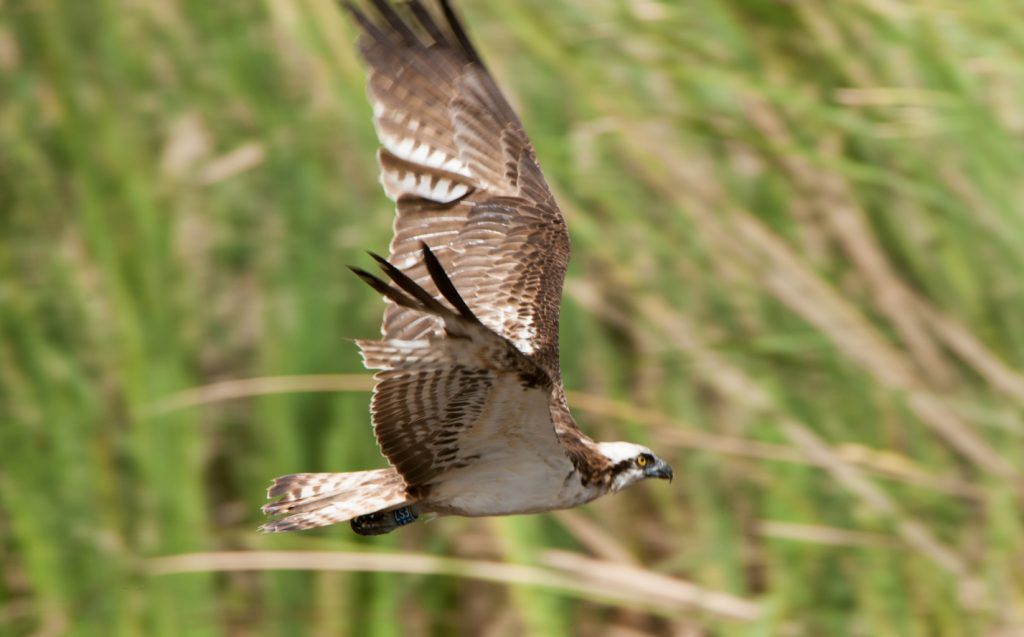
Poole Harbour Osprey Project – 2019 Yesterday, Today, Tomorrow

Posted on: June 20th, 2019 by Birds of Poole Harbour

We’re now also entering the third year of our Poole Harbour translocation project, so we thought as a prequel to this year’s project we’d do a full overview of what’s been so far, what’s what now, and what’s to happen later in the season.

For 2019 it all began on March 21st when the harbour’s first Osprey of the season arrived into the harbour. Over the following few days it was seen again briefly between Middlebere and the Wareham Channel before disappearing on March 24th. A few days later another Osprey was seen staging in the harbour for only a matter in minutes, arriving in from high south before settling down on Arne for a few minutes and then taking off high north again…just amazing to watch.

This winter we also deployed several new SMS motion sensitive cameras on some of the new nesting platforms that were erected around the harbour, and as each day passed in late March our excitement grew in the hope that an Osprey would land on one soon. As time went by Starlings, Jackdaws, Blackbird and even a Wheatear all triggered our camera, but then on April 1st we received a photo that would put a huge smile across our faces. It was the safe return of CJ7, the now 4-year old female originally from Rutland that semi-adopted our released chicks back in 2017 as she was passing through on migration. CJ7 also spent the whole of the late Spring and all summer in Poole Harbour during 2018, before again, adopting our released chicks last August. There’s no doubt that the driving force behind her now regular returns to Poole Harbour are the encounters she had with our released Osprey chicks each year, making her think this is a productive site and there could be other suitable males in the area. Her safe return this spring was a good sign, because it was also the year we could possibly see one or two of our own 2017 birds arrive back for the first time.

CJ7 Returning to Poole Harbour on April 1st

As April progressed CJ7 spent most days on several of the nesting platforms dotted around the harbour, regularly triggering our camera traps, which allowed us to see what she was up to on the nests. Then, in mid-April, we couldn’t believe what we were seeing. CJ7 spent each morning (6am-9am) bringing huge clumps of moss and large sticks to the Middlebere nest, indicating that she had a real drive to breed this summer. This was a hugely encouraging sign, but as it’s usually the males that establish the territories and there are currently no males that call Poole Harbour home then it was unlikely she was going to get lucky this spring. Day after day she would nest build and then spend time looking patiently out to sea, hoping, waiting for a male to arrive on her doorstep, which sadly….he never did. Despite the lack of males, CJ7 still had plenty of company during late April and early May with arrivals of several other females on our nest platforms including blue-ringed PA1, originally ringed near Loch Lomond. Also blue-ring AX8 originally from near Inverness, and an absolute beast of a bird that didn’t have a ring on but we nicknamed her ‘Beaky’ because of her huge bill, that spent a week on the Middlebere nest devouring huge Mullet and Bass twice a day, every day! Separate to Ospreys we saw on our nest platforms, there were also plenty of others that were logged on their migrations north with other birds seen in Lytchett Bay, Wareham Forest, Holton Lee and around the Wareham Channel. With so many sightings during March, April and May it would be safe to say this was one of the best ‘Osprey Springs’ we’ve ever experienced in Poole Harbour.

‘Beaky’ stayed on the Middlebere nest for a week in May

As May rolled into June, and CJ7’s breeding urge depleted, she rarely visited nesting platforms and was only ever seen occasionally flying around the Arne peninsular. All other breeding birds across the UK were now back on breeding grounds so Osprey activity (as expected) dropped off completely. June lazily lumbered on, but we were still on high alert for any reports of ‘new’ Osprey being encountered around the harbour, because we were now in prime time for a two-year old to arrive. Then, on June 12th at 11am, just as we’d finished presenting a talk to our volunteer team about our work as a charity, I received an update from one of our motion sensitive cameras which showed TWO Osprey on one of our nest platforms. A quick dash to the location and a scan of the sky found an Osprey circling high over the Wareham Channel, which we then tried to track down for the whole day. Several times we were close to being able to read the ring number but agonisingly we were just too far away each time. As time passed, we thought we’d never get the number, however a bit of luck and an ease in the rain allowed us to finally get a good look at the leg which allowed us to see the letters ‘LS…?”. Regardless of the number which we couldn’t quite see, the fact we could see LS was all that mattered, as this was one of our boys from the 2017 release. AMAZING!

Since his arrival on June 12th, LS7 has really made himself at home, re-familiarising himself with the local area, and visiting several of our nest platforms. What’s even more interesting is that he seems to have taken a shine to CJ7 who hasn’t left his side since he arrived. The new happy couple have been seen together at numerous sites around the harbour including several of the nest platforms for long periods of time. Although it’s too late for breeding this year, and the fact he’s probably ‘not quite ready’, this interaction really bodes well for next year, just so long as they both have safe migrations this autumn and next spring.

Summer and Autumn 2019

We’re now currently entering the third year of five on our translocation project and at the time of writing we’re busy prepping for the next batch of Osprey chicks to arrive from Scotland in mid-July. With last year’s hardship where some of our chicks died due to a nutrient deficiency brought on by the heat wave, we’ve implemented a whole range of changes to mitigate against the same from happening again, ranging from finding a new release site, employing a larger team, varying the food supply, re-designing the pens, re-analysing our food prep and cleaning procedures. The safe arrival of LS7 and CJ7 has provided the boost the project needed, and the mindset for this summer’s translocation is a really positive one. With this in mind, as a team we need to remain focused on the job in hand so have decided that the translocation work this summer will be carried out by a small dedicated team that will focus on nothing else other than care of the young birds. This means that updates during the raise and release phase will be limited so the team can just focus purely on caring for the birds. Once all of the birds are released and we’re happy each is flying well and safely we’ll then begin providing more updates. With the way things are going, there will be so much going on with other Osprey activity around the harbour that you’ll no doubt be able to quench your Osprey thirst this summer and autumn in the meantime.

Each year we always thank everyone for their support and each year you show us kindness and encouragement in return. The developments this summer with LS7’s return really now make it possible for breeding to take place somewhere in Southern Britain next spring which is the whole objective of the project. When we started three years ago that dream always seemed so far away, but now feels like it could just be around the corner.

From all of us here at BoPH we look forward to an exciting summer and autumn ahead and will update you with progress at suitable times during the course of the project this year.

First Poole Harbour Osprey Arrives Back From Africa

Posted on: June 13th, 2019 by Birds of Poole Harbour

This is the first Osprey to return to Poole harbour from the project, which aims to re-establish a south coast breeding population of this majestic bird of prey. The charity leading on the project, Birds of Poole Harbour were alerted to the birds presence when they received a photo on June 12th from one of their static SMS camera traps which was deployed out in the south of the harbour, indicating that a new blue-ringed Osprey was about.  The team then spent the day looking for the bird so they could read the leg ring to confirm its ID. The charity is now hoping that with the return of this male Osprey, breeding may take place in Poole Harbour as early as 2020 or 2021.

Osprey are a large, fish eating bird of prey that was once widespread across the whole of Western Europe. However, populations were persecuted to extinction through the 18th and 19th century and they sadly never recovered in England.

The Birds of Poole Harbour charity, in partnership with the Roy Dennis Wildlife Foundation and Wildlife Windows began the project in 2017 by bringing 8 Osprey chicks down to Poole Harbour from Scotland where populations are doing better. The team then reared and released the Osprey chicks into the harbour where they then spent several more weeks familiarising themselves with the local area before naturally migrating down to West Africa for the winter

Birds of Poole Harbour co-founder Paul Morton stated:

“This is such exciting news; we can’t believe we’ve actually got one of our chicks back. This is the big next step in seeing Osprey colonise the south coast once more after an absence of around 180 years. When they left the harbour on migration back in 2017, their fate is completely out of our hands, so to know this bird is safe and well having not seen him for two years is just the best feeling”

Ospreys don’t reach sexual maturity until at least 3-4 years old, so there won’t be any immediate success to the project this year. However, his presence in the harbour has already drawn the attention of a female who has been present since April 1st and the two seem to have already shown signs of interest in one another.

Paul Morton added:

“There’s still a long way to go with this project as we’ll be bringing the next batch of Osprey chicks down from Scotland this summer, and more in 2020 and 2021. The support we received from the local community has been incredible, we can already feel the excitement around town. We especially need to thank the landowner for allowing us carry out the project on their land, and also Poole based company Sea Fresh, who provided fish for our birds, which obviously saw them in good stead”

There’s still also a chance more of the 2017 chicks could arrive back to Dorset over the next 2-3 months, so the team be keeping our eyes to the skies for a good while longer yet.

So, in the meantime, please enjoy this footage of when we first saw him yesterday afternoon (June 12th). AMAZING!!!

Eyes on the Sky for Osprey this Spring

Posted on: February 18th, 2019 by Birds of Poole Harbour

First-time returning Osprey usually spend the season prospecting for nest sites and looking for potential future partners. Furthermore, migrant birds attracted to the harbour by our chicks and nest platforms may also show signs of attempting to nest. Needless to say, we’re all on tenterhooks waiting for them to arrive in the next few weeks so we can check for the 2017 chicks returning to the harbour and monitor behaviour of visitors! 

“We are now at an incredibly exciting time in the project as 2019 is the first year that we may see some of our 2017 chicks making their first return from Africa!”

That’s not say that we have been passively awaiting their arrival – quite the opposite! In anticipation for this year’s Osprey arrivals, we’ve put up three new Osprey nests, two on private land and one in partnership with RSPB Arne at Middlebere. Big thanks to Phil Stubbington for his kind donation which allowed us to get these nests installed in time this spring season.

The female below, CJ7, is from Rutland, and is our top pick as the bird most likely to attempt to breed in the harbour first. In 2017, she spent a couple of weeks hanging out with our translocated chicks, and in 2018, she spent the summer prospecting around the harbour. If one of our males joins her this Spring, it’s possible that it could be the beginnings of a future pair-bond. 

All throughout the Spring and Summer, we’ll be closely monitoring and recording all Osprey behaviour at our nest sites and around the harbour. This will allow us to assess which sites and habitat characteristics the Osprey are favouring, which will then mean that we can make improvements where necessary and allow us to make sure that any breeding attempts are not disturbed.

One of our biggest challenges will be reading ring numbers from any colour-ringed birds that pay us a visit. These rings will have been put on birds’ legs when they were chicks, to allow Osprey conservation managers to keep track of where the birds are and what they are up to.

When taking colour ring information, there are four key things to note:

1)    the colour of the ring

2)    the colour of the text on the ring

3)    the leg that the ring is on

4)    the code written on it (always read from the foot up)

Here’s an example from one of last year’s chicks. You can see that her ring colour is blue, the text colour is white, the colour ring is on her right leg and the code is 014. 

014 – Paul Morton

With that in mind, and thanks to donations from supporters Jan Toomer, Phil Stubbington and Mike Simmonds, we’ve invested in some brilliant technology – 4G trailcams! These are motion-triggered and will directly email us with images of anything that moves in our nests, making it much easier to read leg rings without disturbing the birds – pretty cool! We’ve already had some lovely (though non-Osprey) images from one camera, including this small flock of beautiful Starling. In terms of Osprey behaviour, we’ll have our team out this spring stationed at key locations around the harbour where we believe Osprey activity will be most interesting. Everything from feeding, hunting and perching behaviour will be logged and noted and of course, interaction between two birds will be especially interesting!

If you spot an Osprey in the harbour over the Spring and Summer, we’d love to hear from you! You can Tweet us @harbourbirds, email us at info@birdsofpooleharbour or you can phone us on 01202 641003.

Poole Harbour Osprey Translocation 2018 End of Season Update

Posted on: October 17th, 2018 by Birds of Poole Harbour

We expected the first of this year’s translocated chicks to leave around a month after release and, sure enough, the first to set off, 013, headed south at 10:30am on August 30th. Chick 014 followed the next day and the remaining birds left over the course of the next three weeks. The last to depart, 002, was kept grounded for several days of wet and windy conditions, but a change of weather on September 21st was his cue to depart. After an early morning feed at the release site, the young male left a favourite perch, slowly circled to gain height and then headed off purposefully south. He was ten days later than any of the birds last year but had chosen the perfect morning to leave. It is amazing to think that by now he’s probably in southern Europe or perhaps even West Africa. Having lingered around the release site for 47 days after release, 002 would certainly have left in good condition with 3-sqaure meals per day in him! The post-fledging period – the time between their first flight and migration – is of critical importance for all young Ospreys. It helps the juvenile birds to develop confidence on the wing and also to build up strength for the long flight south. Crucially, it is also when young Ospreys imprint on their natal site, and therefore when the translocated birds learn that Poole Harbour is home.

Back in early September we also reported to you the difficulties our translocation had faced which resulted in several of this year’s birds passing away. At the time of writing, one of the birds, 005, had been taken to Cotswold Wildlife Park for treatment but, after initially making some progress, later deteriorated and also died a few weeks later.  As reported at the time, tests were ongoing as we needed to make sure every part of our process was analysed properly, allowing us to get a true and full understanding as to what was happening. Our team reacted extremely fast and we left no stone un-turned during this examination. Ensuring no infection or disease was being spread across the birds was ultimately the first most important factor to be addressed. Luckily, initial tests indicated no sign of this, and we were confident our issues laid elsewhere. We had our food sources professionally analysed several times as well as our water supply and results from those tests also showed that neither were directly responsible for the deaths. Ongoing tests by the pathologists at Cotswold Water Park indicated that it looked as if a Thiamine (vitamin B1) deficiency could be main cause of death. Thiamine levels in our food supply hadn’t been analysed during the first round of tests due to the complexities of that type of analysis, so food samples had to be sent to a lab in Europe for further analysis. Tests from those samples indicated some low levels of Thiamine, however it has now been concluded that a number of underlying issues in the birds, that would not normally manifest themselves, were exacerbated by another main factor; this summer’s heat wave, which impacted on the birds’ nutritional intake and individual development. It’s no coincidence that it was the older, stronger set of birds that survived this year.

Having a clearer understanding of what happened this year now allows us to implement and plan for next year, like making sure we only select birds of a specific age or older. However, we will continue to work with an expert team of avian pathologists from the International Zoo Veterinary Group to determine any other underlying causes of these deaths. Yes, the project faced hardships this summer, however it’s easy to overlook the many positives that also developed over the course of the year, of which there were many. Firstly, this summer/autumn saw a big increase compared to last year in the amount of interaction between our translocated chicks and migrant Osprey that were passing through the harbour. The day after the first release on July 31st, two migrant Osprey spent several days visiting our freshly released youngsters at the release site, often flying down and hovering over the feeding nests. In early August, up to three migrant Osprey were then active in and around the release site, often being joined by one of our birds in the air for a few minutes.

As our birds became a bit braver and bolder they began exploring further afield and many visitors to RSPB Arne nature reserve were treated to wonderful views of 007, 008 and 014 for several weeks as they pursued and pestered fish carrying adults to, on and away from the Middlebere nesting platform.

Our youngsters also began exploring the Wareham Channel, which is Poole Harbour’s premier fishing zone for Osprey during the spring and autumn, and it was here that we witnessed two amazing sights, both whilst hosting our public bird boats. Firstly, on August 24th we received a phone call from one of our volunteers that 008 was heading towards us and, sure enough, she appeared from over the top of Arne Hill where she then spent 20 minutes practice fishing and dropping into the water like she’d been doing it for years. Secondly, on August 27th we noticed from our boat trip that one of the nesting platforms on the Arne shoreline had a migrant Osprey sat on the feeding post with a fish, but, most amazingly of all, another Osprey was poking it’s head out from within the nest itself. We contacted our volunteers who had the radio tracking equipment and they were confident it was 013. Just amazing and, even better, a guest on board managed to get a distant record photo of the event.

You may be asking why all of this is important? The reason is because when migrant Osprey are passing through the harbour, and they then encounter and engage with our youngsters, it totally changes the dynamics of how those migrant Osprey see Poole Harbour – as a productive site for nesting. This in turn will then hopefully draw migrant Osprey back to Poole Harbour to breed, as well as our translocated chicks, and that’s exactly what we saw this spring. Last year, a non-breeding, two-year old female from Rutland called CJ7 spent a week in August ‘hanging out’ with our chicks in and around the release site before migrating off south for the winter. Tim Mackrill said at the time, “I bet she comes back to Poole Harbour next spring”. She did just that. This spring, a blue-ringed Osprey was seen arriving into the harbour and after a day was tracked down so that the ring number could be read; it was CJ7 who initially spent a week feeding from a favoured perch on RSPB Arne before adopting one of the nesting platforms for a further three weeks, and was even seen sitting in it several times. This was very exciting, however, because there were no males in the area wanting to set up a territory, she sadly spent the rest of the summer on her own.

Could that be about to change this coming spring? In April and May 2019, we could start seeing some of our released birds from 2017 arriving back for the very first time. If any do, it’s unlikely they’ll breed. However, if they come back and engage with CJ7, or any other migrant Osprey that now regard Poole Harbour as a potential breeding site, then things could start getting very interesting very soon and we’ll certainly be on the look out to try and track down any colour-ringed birds next year.

Finally, we’d also like to mention the public focus and interest the project has developed. The primary focus is to establish a south coast breeding population of Osprey, but naturally this type of work will attract plenty of positive public attention and we’re already beginning to see the local benefits. In 2017 we hosted just three Osprey boat cruises to celebrate the launch of the translocation and each of the three trips sold out. This year we decided to host nine trips and yet again all of them sold out. Over those nine days we engaged and enthused with just under 500 people, many of who had never seen an Osprey before. As luck would have it, it was a great autumn for migrant Osprey and each trip saw between 3-6 migrants as well as some of our translocated birds. The team at RSPB Arne also began running early morning Osprey walks on their reserve which were well received and will hopefully become a regular feature each August and September.

So, to wrap up our 2018 season, we’d again like to thank everyone for their support, kind words, financial contributions and generosity when it came to this year’s translocation. When our team were at their lowest, you were there for us and as a thank you we promise that, despite this year’s struggles, we’ll make the Poole Harbour Osprey translocation project the success it deserves to be, so that the birds can flourish and future generations can witness nesting Osprey on the south coast once more.

Osprey Translocation Project Update

Posted on: August 20th, 2018 by Birds of Poole Harbour

The aim of the project is to help restore a South Coast breeding population of Osprey for the first time in over 200 years, and in doing so help fragmented populations across Western Europe to link up and expand.

This summer, the team received fourteen new chicks from Scotland, which were collected under licence by the Roy Dennis Wildlife Foundation and translocated to Poole on 11th July.

The first birds were released on 31st July, and further releases were undertaken over the course of the next week. Seven of these birds are now exploring the harbour, including Arne and Middlebere and interacting with several migrant adult Ospreys who are also present. However, over a six-day period, from 6th August to 11th August,six birds, including four which had yet to be released, devastatingly, died.

On 5th August, we started to notice signs of ill health with two birds. Immediate action was taken to assess the cause of this deterioration and following the first unexpected death during the night of 6th August, each of the ill birds were taken to the Cotswold Wildlife Park for urgent veterinary assessment and care. Sadly a total of five birds with similar or identical symptoms died. Bacterial and viral infections were ruled out, and further precautionary tests were carried out, including a review of our process, so we could begin identifying possible causes.

Having liaised with the pathologists and veterinary experts, it is thought that a nutritional Thiamine deficiency has been a significant contributing factor in the deaths. This is likely to have been exacerbated by this summer’s extreme heat wave, which is known to have caused problems for a range of other different species. Blood tests continue to be carried out to confirm this and we hope for the results in the coming days.

In a separate incident, one of the released birds which had been out flying for over a week was found drowned off the east side of Round Island, having become tangled in a ball of thick algae.

This sequence of events has been extremely shocking for the project team, but identifying the cause of death and the care for the remaining birds have been key priorities over the last ten days.

We thank you for your patience regarding this news.

A Sad and Challenging Six Days – Osprey Project Update

Posted on: July 12th, 2018 by Birds of Poole Harbour

 The aim of the project is to help restore a South Coast breeding population of Osprey for the first time in over 200 years, and in doing so help fragmented populations across Western Europe to link up and expand. This project is part of the wider plan for the recovery and conservation of Osprey in Europe and the Mediterranean which was written by Roy Dennis on behalf of the Council of Europe and follows long-established techniques for the rearing and release of translocated Ospreys.

This summer, the team received fourteen new chicks from Scotland, which were collected under licence by the Roy Dennis Wildlife Foundation and delivered to the Poole project team on 11th July. The birds were kept in the same specially designed release pens as last year and fed the same diet of locally sourced fresh fish. All were fit and healthy and on 31st July and 1st August, the first five birds, 003, 007, 011, 013 and 014 were successfully released and quickly grew in confidence on the wing. A second release was planned for the following week.

On 5th August, two of the birds yet to be released began to show serious symptoms of ill health, including spasms and seizures, that were unfamiliar to the project team or its partners. We monitored both closely and sought veterinary advice. Then, during the night of 6th August, a third bird suddenly began to display identical symptoms and quickly and unexpectedly died. The deceased bird was taken straight to a veterinary specialist for a post-mortem at Cotswold Wildlife Park. The team there, led by Jamie Craig, have extensive knowledge of a wide range of different bird species and long-established links with highly experienced avian vets and other experts. As a precaution, the two ill birds were also taken to Cotswold Wildlife Park for intensive care.

A suggestion was that given the neurological symptoms we had observed, a possible cause was a thiamine (vitamin B1) deficiency. The birds were given a thiamine injection as a precaution, but various tests would be required to confirm the diagnosis. 

In the meantime, four of the remaining birds, 002, 008, 010 and 012 were considered ready for release, which was undertaken on the morning of 7th August. As a precaution, vitamin supplements, that included thiamine, were added to the fish we provided twice daily for both the released birds and those still in the pens. Some 36 hours after it made its first flight, one of the released birds, 010, also began displaying symptoms of ill health. It was put back in one of the pens overnight but quickly deteriorated showing exactly the same symptoms as the other ill birds and died the following morning. Not long after this we also received news from the team at Cotswold that one of the birds we had taken into care two days previously had been found to have damage to its lower back and leg, potentially caused by the spasms, and the decision was made to euthanize it. Furthermore, another of the birds yet to be released, 004, had developed fast deteriorating symptoms overnight and it too died before it was possible for it to be assessed by the specialists. The last remaining bird in the pen, 006, which was not ready to fledge, was taken to the specialist vet as a precaution as it too began to show similar symptoms. It was given a thiamine injection on arrival but deteriorated over the course of the next 24 hours and also died.


In under a week we had lost five of our fourteen birds.

Then, on the evening of 8th August, we found that one of the first birds to be released, 003, which had been flying strongly, feeding well and exploring the further reaches of the harbour, had drowned after becoming tangled in dense weed on the shores of an island that is only accessible by boat. This was most probably unrelated to the deaths of the other birds, and a danger all young Ospreys face during their first weeks on the wing but given the events that had unfolded in the previous few days it was a severe blow.

The speed with which the young Ospreys had become ill and died was both shocking and devastating, not least because we are still unsure of what had caused their sudden deaths. The protocols we used this year are identical to those used in our successful first year and we are unaware of any similar mortality events occurring in any other Osprey translocation projects.

As a matter of urgency, we began running tests on our food and water supplies and re-evaluating our daily procedures. The pathology results from the lab ruled out a bacterial and viral infection, which was important as it meant the health of our free-flying birds would not be affected. Tests are on-going but with each of the deceased birds displaying identical symptoms prior to death, the specialists are all in agreement that a thiamine deficiency is almost certainly a main contributing factor.

Thiamine (Vitamin B1) is required for a basic cellular metabolism and is crucial in the development of young birds and animals. Blood tests have been conducted to see whether a thiamine deficiency in the birds is present and we hope to have the results from these tests back very soon.

This has been an incredibly tough week for all the project team, our volunteers and our partners. We will continue to test and assess our deceased birds to provide a clear set of data for a robust analysis.

Some encouraging news is that 005, one of the first birds we took for treatment at Cotswold Wildlife Park, is showing real signs of improvement. It was initially suffering from near paralysis in both legs, but thanks to the swift action of Jamie Craig and the team at Cotswold Wildlife Park, we think that the thiamine injection they gave it on arrival may have saved it. There is still a great deal of rehabilitation required, but it is encouraging that the bird is showing consistent signs of improvement. Interestingly, sixteen Herring Gulls, which were found alive but with paralysis on the Baltic Sea coast, recovered completely after being treated in a similar way, with birds that were not treated in this way all dying. (Balk et al., 2009). We hope that 005 will recover sufficiently to be released in time for migration.

A project of this scale and ambition will always face challenges: what is important is the manner with which we respond to and learn from such challenges and, crucially, how we use our expanded knowledge base to continue to strive for our overall objective. Other projects have faced similar challenges, including the first year of the Rutland Osprey translocation project when sadly four of their first eight birds died from Salmonella poisoning. Nonetheless, Rutland is now home to a well-established population following the first successful breeding attempt in 2001.

As with Rutland, valuable lessons have been, and are still being, learnt within our project. We are extremely proud of the perseverance and dedication of our team and everyone who has fought to help our birds over the past week. Despite this year’s setback with our project, we can still take heart in the fact that we have released another seven healthy Ospreys who are now out and enjoying Poole Harbour, and already mixing and interacting with migrant Ospreys that are currently passing through. We were also happy to hear that last winter three of last years released birds were photographed down in West Africa which is testament to the process we had in place last summer. We very much hope that 005 will be joining them again in a few weeks’ time. We remain determined to restore a population of these wonderful birds to the South Coast.

We hope to have more information over the coming days but in the meantime, we thank you for your patience and support. We also owe our sincere thanks to Jamie Craig, Emily Boyes and the team at Cotswold Wildlife Park for their incredible support and advice during this very difficult period.

The Poole Harbour Osprey Project Team.

References

Balk L, Hägerroth P-Å, Gustavsson H, Sigg L, Åkerman G, Hanson M, Tjärnlund U, Hansson T, Hallgrimsson GT, Zebühr Y, Broman D, Mörner T and Sundberg H. (2009) Wild birds of declining European species are dying from a thiamine deficiency syndrome. Proc. Natl. Acad. Sci. USA 106, 12001–12006

Balk L, Hägerroth P-Å, Gustavsson H, Sigg L, Åkerman G, Muñoz YR, Honeyfield DC, Tjärnlund U, Oliveira K, Ström K, McCormick SD, Karlsson S, Ström M, Manen M van, Berg A-L, Halldórsson HP, Strömquist J, Collier TK, Börjeson H, Mörner T, Hansson T (2016) Widespread episodic thiamine deficiency in Northern hemisphere wildlife. Sci Rep 6:38821. doi: 10.1038/srep38821

A Sorry ‘Tail’ of yet Another Poole Harbour Osprey Chick Sighting in West Africa

Posted on: April 4th, 2018 by Birds of Poole Harbour

However, sadly, this story doesn’t have happy ending. We received news that the leg rings of LS6 had been found on the outskirts of a village, but other than we had no more info. Well, with a bit of digging and calling on international connections, our project partners the Roy Dennis Wildlife Foundation have been able to find out more and have also been sent some (sad) photos. The photos show a carcass, which is said to be LS6 who had been found by locals several weeks ago. There are no obvious signs of damage on the carcass, but there is an odd twist in this ‘tail’.

LS6 – Paul Hill

No sooner had we received news of LS6’s death, when Tim Mackrill was suddenly sent an image of LS6 alive! As it transpires the photo was taken about two weeks prior and only 2km from where he was finally found. What’s interesting is that if you look at the photo of LS6 alive, he seems to be missing the whole of his tail. Had he had a run in with a crocodile? (quite frequent in Africa apparently)! And did the lack of balance when hunting make him a less efficient hunter? Who knows, but what we do know is that sadly we’re one chick down (that we know of). This was always to be expected as there is a high mortality rate for Ospreys on their first migration south. Further information can be found here.

But don’t be too down heartened. We’re now in early April and migrant Osprey are being seen back in Poole Harbour again. These aren’t birds related to our project as they won’t be back until next spring, rather they’re adult birds making their way back to breeding grounds further north. So with spring now in the air, why not head out to somewhere like Arne, Middlebere or the Rockely view point to try and see if you can see one of these amazing birds before they head off north.

Another Poole Harbour Osprey Chick Seen in West Africa

Posted on: February 9th, 2018 by Birds of Poole Harbour

We announced two weeks ago that one of our Osprey chicks (LS7) raised and released into Poole Harbour last summer was seen in Western Senegal in late January. This was a rare and unexpected sighting. Today, we’ve just received a photo from a birder who was down in Africa over the New Year who had (unknowingly at the time) photographed ANOTHER one of our chicks…this time LS3!!! More astonishingly it was only 21km away from where LS7 had been seen recently. To receive news of one bird was a rare event in itself but to have a photo of a second a few weeks later is unheard of. We’re absolutely thrilled as this is a really positive sign that at least some of our chicks are fit and well having made their first long and dangerous migration to west Africa.

To read more about this sighting, head to Tim Mackrill’s blog on the Roy Dennis Wildlife Foundation Website.

LS3 – Jose Louis Carlo

Osprey Chick LS7 Seen in Western Senegal

Posted on: January 25th, 2018 by Birds of Poole Harbour

 Tim Mackrill from the Roy Dennis Foundation received news from a warden friend of his in Western Senegal that one of our chicks from the 2017 release, LS7, has been seen safe and well in the Sine-Saloum Delta. This is just brilliant. This area is a well know Osprey over-wintering hot spot that Tim has visited before in which he states “you couldn’t choose to be anywhere better during the winter if you’re an Osprey than there…LS7 has chosen well”

To describe and highlight just how good this location is Tim has written an excellent blog post on the Roy Dennis Wildlife Foundation website.

Poole Harbour Osprey Chicks Take Flight

Posted on: August 14th, 2017 by Birds of Poole Harbour

The chicks which were collected from healthy sustainable populations in Scotland and are part of a five-year translocation project have been held in large holding pens over-looking Poole Harbour and have been cared for by a team of volunteers over the last three weeks. The fully-grown chicks will spend the next 4-6 weeks within Poole Harbour, familiarising and imprinting themselves on the local area before migrating down to West Africa.  The project which is being run by local charity ‘Birds of Poole Harbour’, Scottish charity ‘The Roy Dennis Wildlife Foundation’ and local wildlife technology company ‘Wildlife Windows’ was given the go-ahead this spring and its hoped that over the next 4-5 years Ospreys will adopt Poole Harbour as their new home and re-colonise the south coast.

Osprey were once widespread across the whole of western Europe but became extinct in the UK by the mid-1800’s mainly due to human interference and as a result struggled to recover across this region. The five-year project will see Osprey chicks being brought down to Poole Harbour each July until 2021. Male Ospreys normally return to their natal areas to breed, and it is hoped that this year’s translocated birds will return for the first time in 2019.

Osprey, which feed exclusively on fish, pass through Poole Harbour every year on migration, attracted by the abundance Mullet. In late August the harbour can host up to 6 Osprey at any one time as they fatten up before their long migration down to West Africa.

Since the chicks’ arrival in mid-July the volunteer care team have been feeding the birds 3 times a day on chunks of fish. The success of the project wholly relies on the birds having zero contact with humans, so plates of fish were deposited through small letterbox style flaps at the back of the pens. Now that the birds have been released fresh fish will be placed on artificial nests close to the release pens until all of the young Ospreys migrate south. The Osprey team has received welcome offers of support from local companies with Poole based fish suppliers ‘Sea Fresh’ kindly donating fresh fish to help feed the chicks and well know Poole restaurant ’Storm’ offering storing and prepping facilities.

Paul Morton from the ‘Birds of Poole Harbour’ charity stated:

“To see our first eight Osprey chicks now flying free is just incredible. We began working on the application for this project almost two years ago now, and it seemed like a lifetime away before we got to this stage. We hope this will engage and encourage people to get out and enjoy watching these incredible birds of prey before they head of south for the winter. The offers of help and fresh fish from Storm and Sea Fresh have been vitally important to the project and will help to ensure that the young Ospreys are in the best possible condition when they depart on migration.”

The volunteer team are now monitoring and tracking the birds’ movements around the harbour using tiny lightweight radio tracking devices mounted on each of the chick’s tails. The monitoring of the birds after release is a hugely important time and the team would welcome any sightings of Ospreys over the coming weeks and specifically ones with blue leg rings on their right leg showing the letters LS and then a number. It’s expected that throughout August, as the chicks get a bit more adventurous, they’ll begin exploring the whole of Poole Harbour with areas such as Arne, Middlebere and the Wareham Channel being good places to see Osprey activity.

World-renowned Osprey expert Roy Dennis from the Roy Dennis Wildlife Foundation said: “We are delighted to see the young Ospreys now flying around Poole Harbour. The next few weeks are an incredibly important period as the birds grow in confidence on the wing and prepare for their first migration to West Africa. This is another step towards restoring a population of Ospreys on the south coast of England.”

Call 01202 641 003