The Carey Ospreys

Posted on: May 11th, 2023 by Birds of Poole Harbour

Since 2017, Birds of Poole Harbour and the Roy Dennis Wildlife Foundation have been working hard to re-establish a South Coast breeding population of Osprey; a majestic bird that really captures people’s imagination. Since the story began, an ever-growing community of people from near and far have followed the project and offered their support, sharing our excitement through its twists and turns. For many people this connection began in 2020, when we launched the livestream nest camera and CJ7 found her way into people’s hearts, providing a much needed distraction for thousands of us during the early months of the pandemic. Our hopes grew the following year, with the return of our translocated male 022 and the strong pair-bond we watched him form with CJ7. 2022 then delivered the outcome we had been waiting for, when the pair made history by raising two chicks and became the first breeding Ospreys in Southern England in nearly 200 years. Having both safely returned this spring, we’re now in the exciting position to be able to share the next part of this story with you, by hosting a series of guided viewing experiences at the site where the pair have taken up residence.
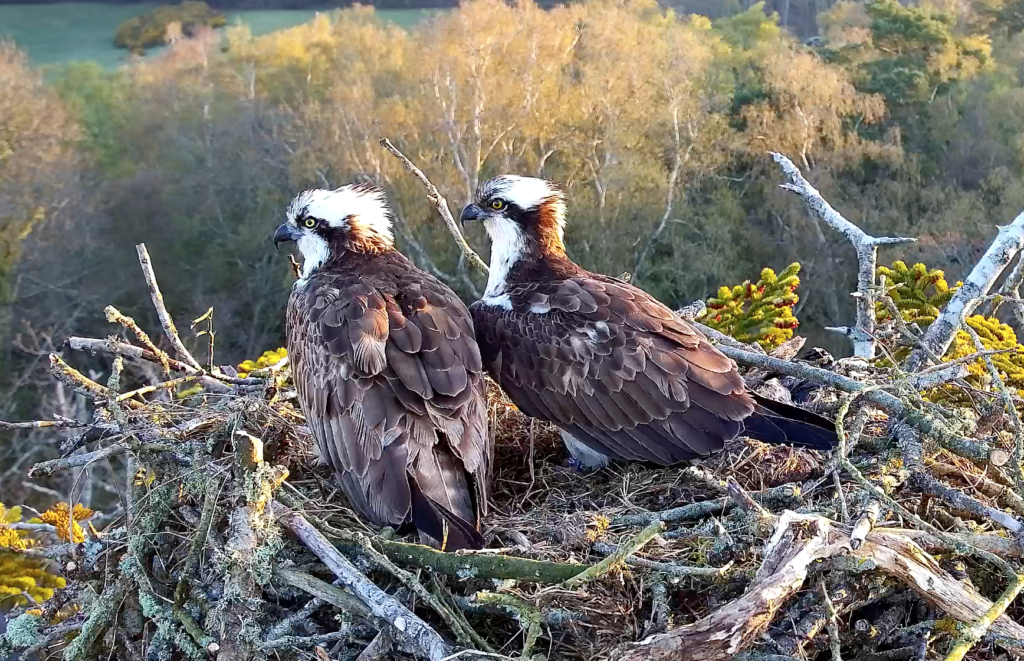
Seeing the special attachment that people have formed to the pair and their story has been one of the most rewarding elements of the whole project, alongside witnessing just how well this incredible bird of prey can re-establish in this part of the country: soaring over Poole Harbour and hunting on the edges of the conurbation. Like so many of our lost species, they belong in this landscape and that they are wanted here, as is evident by the number of people who now visit the area specifically to see and learn about the Ospreys. This eagerness to see the birds, though, must also be carefully balanced against their sensitivity to human disturbance, particularly around their nest site.

Over the last year, more and more people have inevitably discovered where the pair are nesting, and we have been incredibly grateful for their cooperation in keeping the location to themselves. Most importantly, this has given the pair space to settle and have a successful first season, but it has also allowed us to build a plan to provide a secure guided viewing opportunity at the site with the bird’s best interest in mind. To be able to achieve this, we have been lucky enough to form a partnership between Birds of Poole Harbour and local business Careys Secret Garden; a beautiful walled garden nestled in the Piddle Valley that is perfectly situated to provide guided viewing of the Osprey nest.

Careys Secret Garden is an award-winning business that puts the local community and wildlife at the heart of what they do, offering garden visits and hosting a brilliant array of events throughout the year. 
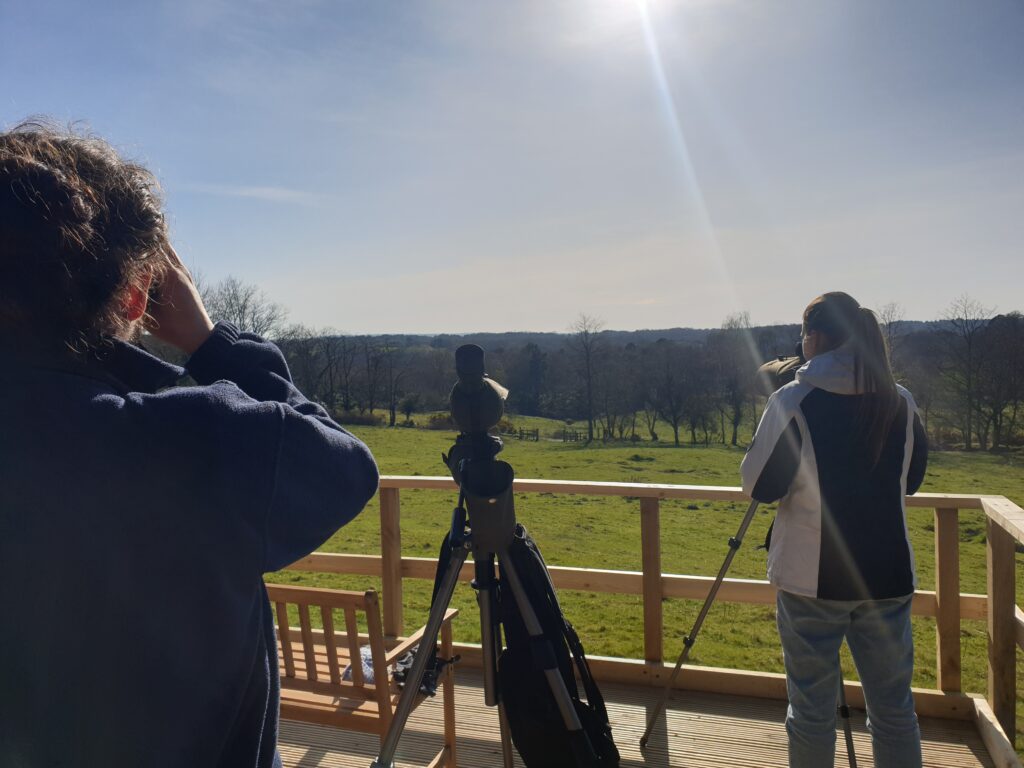
They have helped us keep the nearby Osprey pair a secret over the last year, with just a few observant garden visitors noticing the aerial Osprey activity over the garden. We are now excited to be partnering with them to add Carey Osprey Tours to the events offered by the gardens, with three sessions each day on Thursdays, Fridays and Saturdays. These two-hour tours will be led by an expert from the Birds of Poole Harbour team and will be bookable online in advance, with initially only 6 tickets available per session. The tickets include an in-depth guided tour up to a new Osprey nest viewing platform, with the opportunity to learn more about the Poole Harbour Osprey Project from your guide, as well as access to the stunning walled garden and its facilities for the duration of the day.


The public’s enthusiasm and care has been integral to the successful conservation of Ospreys in this country right from the very beginning, ever since public viewing was first permitted at RSPB Loch Garten back in the 1950s. This engagement work – which has since been replicated at sites across the UK and abroad – not only compliments ongoing efforts to safeguard Osprey nests, but even enhances them, by educating a wide audience and ensuring that many watchful eyes work together to protect the Ospreys from harm. We hope this story will continue in Dorset and by sharing the location of the nest we are putting our faith in the public to act as custodians of the species once again. Careys Secret Garden shares our appreciation for just how special it is to be able to provide viewing access to the only Osprey nest on the South Coast, and the responsibility that comes with that. The viewing of the nest at Carey is therefore being very carefully managed to avoid any risk of disturbance, with only small groups permitted at any one time, so please make sure to book onto one of the tours in advance if you would like to visit and share this experience with us. 

From the moment the pair returned this season, our staff and volunteers have worked hard to monitor their behaviour, whilst also assessing their reactions and acclimating them to the presence of small groups of onlookers watching from a platform at a safe distance from the nest. Despite Ospreys being real creatures of habit, we have been very encouraged by how well CJ7 and 022 have adapted to this small shift in their surroundings. Of course, the success of the pair is our priority, and so if there are any signs of detrimental impact as a result of our tours, we’re sure you will understand our need to pause these events and review our activities on site.
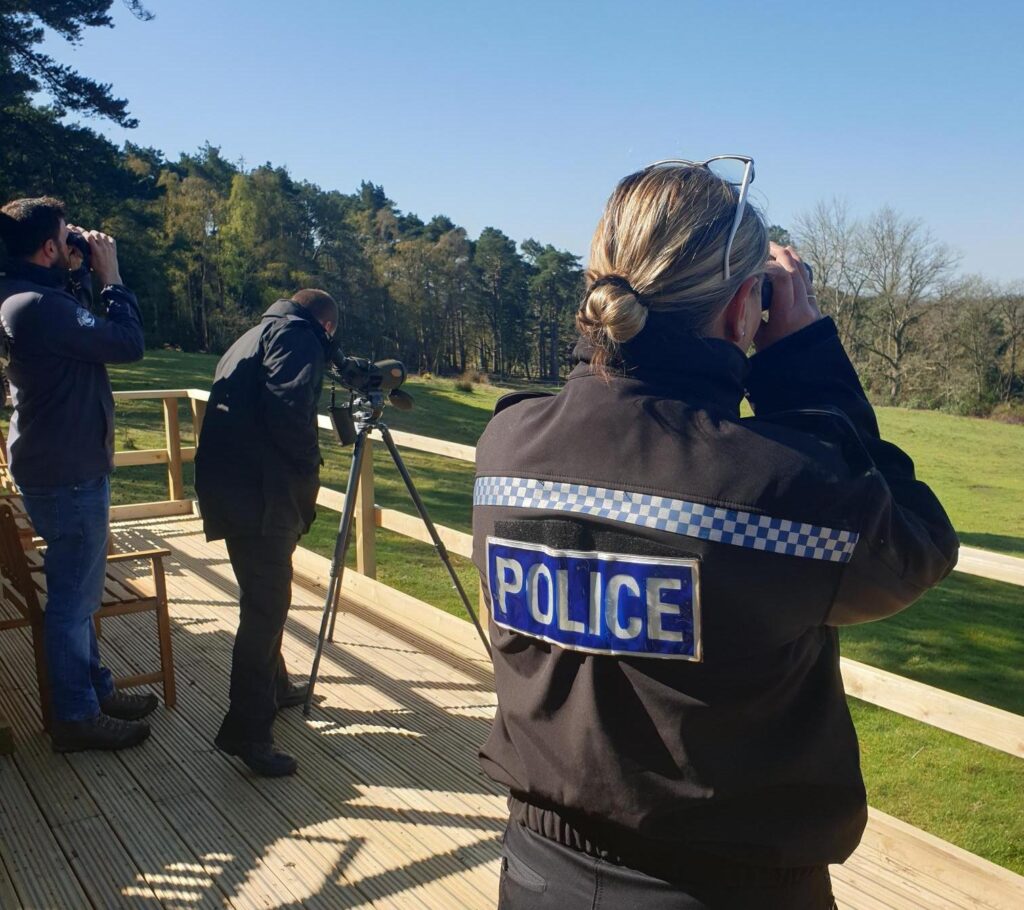
Osprey are a Schedule 1 species, meaning they have the highest level of protection under the Wildlife and Countryside Act. This means it is an offence to intentionally or recklessly disturb the species near to, at, or on an active nest, providing a legal base for any disturbance issues the pair may face. Like last year, the nest will still be protected each day, with our dedicated team monitoring the nest and surrounding area, and additional protection provided by security units at key locations. We’re also working closely with Dorset Police Rural Crime Team and the National Wildlife Crime Unit to ensure there is no disturbance or trespassing risks to this private site.

These first stages of recovery of Osprey on the South Coast are symbolic of a great deal of hard work and inspiring conservation efforts being made to restore nature locally. It’s very exciting to be able to share this next phase of the story with you, and, with three eggs currently being incubated, it hopefully won’t be long until we have more wild Osprey chicks fledging in Dorset. Here’s hoping for another successful season for CJ7 and 022!

Book your place on our Carey Osprey Tours here!

Plastic in the Osprey nest

Posted on: April 12th, 2023 by Birds of Poole Harbour

Since their return, our Osprey pair have both been busy adding material to their nest in preparation for breeding. This has included a variety of natural objects including moss and grass to line the nest cup and sticks to build up the nest wall. However on Friday 7th April our male 022 brought in a far less desirable lining material: a sheet of black plastic. Over the course of the bank holiday weekend he brought in several more pieces, some of which have since blow away (a preferable outcome for the Ospreys but not for the habitats they will have blown into), though the original piece remains weighed down by added later sticks.

We believe that the plastic is discarded agricultural waste that has come from nearby farmland. In order to reduce the risk of any more being brought in we have been out looking for potential locations where 022 might have collected it and we are very grateful to the neighbouring land owners who have agreed to inspect their own land and ensure any such material is removed. To an Osprey flying overhead any loose plastic sheeting such as bale wrap moving in the wind likely looks very similar to grass, and unfortunately large chunks can easily be torn off in their strong talons. Once in the nest, it catches easily on surrounding twigs and gets gradually buried as more material is brought in, making it less likely to be dislodged by the wind or the birds. Sadly is it all too common to see plastic in the nests of wild birds, and Ospreys are no exception: materials such a baler twine are often collected in a similar way, and can pose an even more serious threat of entanglement for chicks and adults. Though theoretically less severe, black plastic sheeting can still pose a potential risk to the Ospreys, and this is obviously not a desirable state of affairs so early breeding season.

In an ideal world we would be able to quickly climb the nest tree to remove the man-made material, but there are a number of  other risks and limiting factors associated with this process, which must be weighed up against those of leaving the it in the nest. The first is disturbance to the birds, which could be especially detrimental at the present stage, when CJ7 is likely to begin the laying process any day now. We would not want to negatively impact them at a crucial time and risk an extreme outcome such as nest abandonment or failure. Should we conclude that the risk of this is sufficiently low and chose to make the climb up the 25+ metre nest tree, we would require a suitable weather window to do so safely. The high winds forecast for the coming days are likely to either delay this process or prolong the time it takes to reach the nest, meaning a greater potential disturbance impact on the birds. There is of course a chance that these high winds may help to dislodge the plastic but this is not guaranteed.

We will be taking all of this into account and assessing the situation further in the coming days, and will aim make a decision as to the best course of action as soon as possible. Whatever conclusion we reach however, we will ensure that it is in the best interests of the Ospreys and their success.

CJ7 in the nest with the black plastic on the right

Poole Osprey Season 2022 Overview

Posted on: March 23rd, 2023 by Birds of Poole Harbour

Now that our new Osprey cameras are up and running and being live streamed in goodness knows how many houses, offices and classrooms across the country, we thought it would be a nice idea to provide an overview of last year’s events, providing significant dates relating to various milestones during the season. To complement this information, our volunteer Alison Copland has compiled a wonderful video which features multiple heart-warming, funny (and some not so funny) sequences that have been clipped from last year’s live stream.

We estimate it’s only between 10-15 days until our pair could return back, possibly even sooner considering how strong the wind is that’s currently coming up from southern Europe over the next week. These strong winds could provide perfect migrating conditions for many migrating birds, not just Ospreys, as they use the tail wind to travel across larger than normal areas on route back to breeding grounds.

Having watched the video multiple times since Alison sent it to us, it’s easy to forget just how eventful, exciting and fascinating last seasons escapades were. We hope you enjoy the video and are keeping everything crossed for another (even better) successful year.

For reference, below the video is a list of significant dates from last year’s breeding season.

Poole Osprey Season 2022 Overview Film

Poole Osprey Season 2022 Overview

New Poole Harbour Osprey Webcams Go LIVE!

Posted on: March 21st, 2023 by Birds of Poole Harbour

After a long, cold winter, and months of anticipation, we’re thrilled to announce that our new and improved Poole Harbour Osprey nest cameras are now LIVE.

Last summer saw the historic moment that our Osprey pair CJ7 and 022 raised the first two Osprey chicks in southern Britain for nearly two centuries. The season and spectacle was enjoyed by many thousands of people and we hope that this year will excite and inspire even more.

It’s been a busy winter, with our team building new Osprey nest platforms across the area, servicing the old ones and planning for the year ahead. A major part of our work this winter has been to look ways we could improve the experience for people tuning in online to watch Dorset’s celebrity Osprey couple. Last year we were incredibly lucky, as we had only decided to place a camera on this particular nest as a ‘backup’, after the pair were seen visiting on a few occasions the previous autumn. With only limited time available before they returned we rushed to get a camera in place at the very last minute, and hence the camera quality and position ended up being not as good as the one on their original nest. However, we were incredibly relieved that we had managed to get something in place, as when CJ7 returned less than a week later she went straight to this new site, without even bothering to return to her previous nest. Once she’d settled at this new site, it was only a matter of time before 022 joined her on April 10th 2022, and the pair took straight to making this new nest their home for the season.

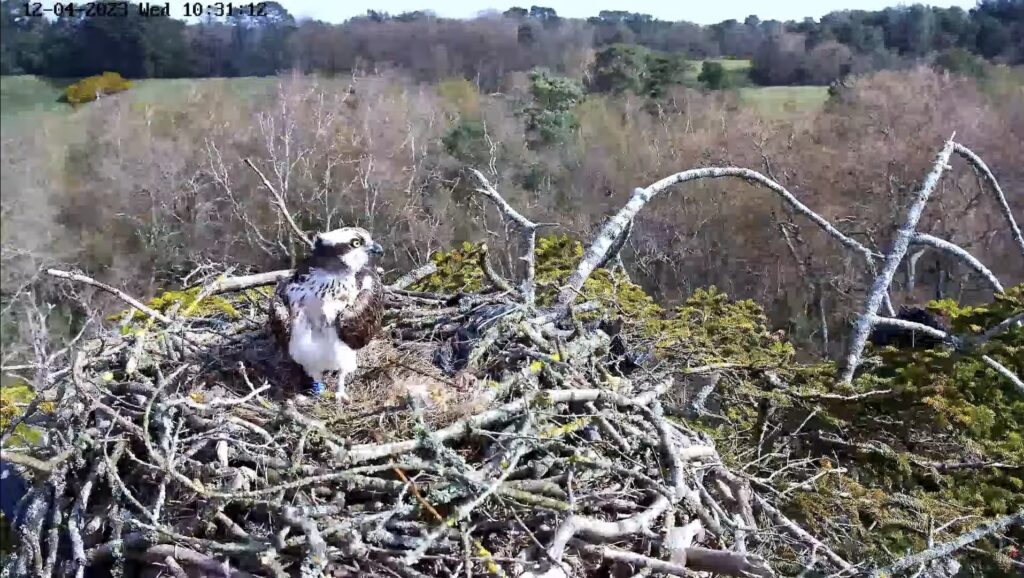
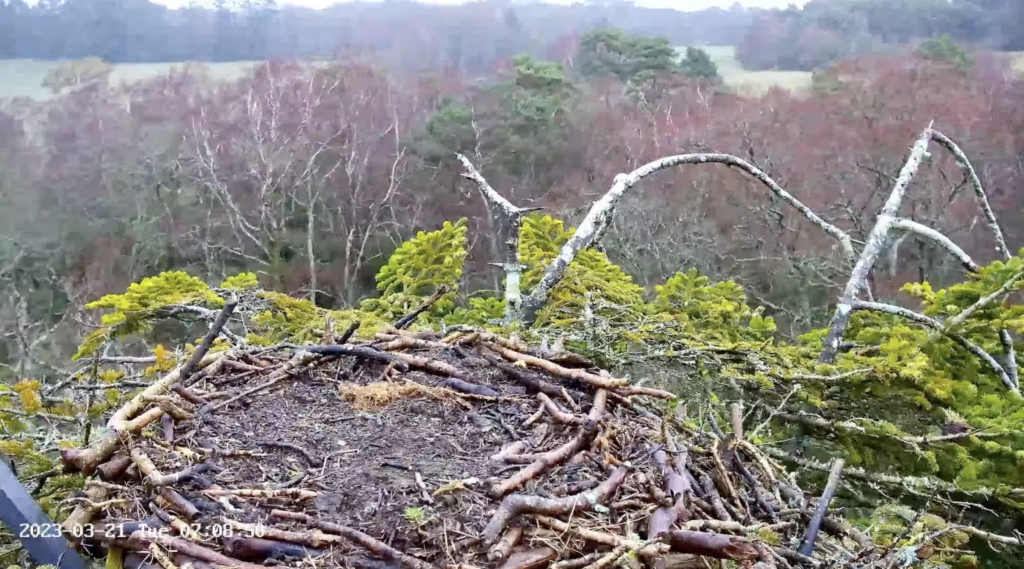
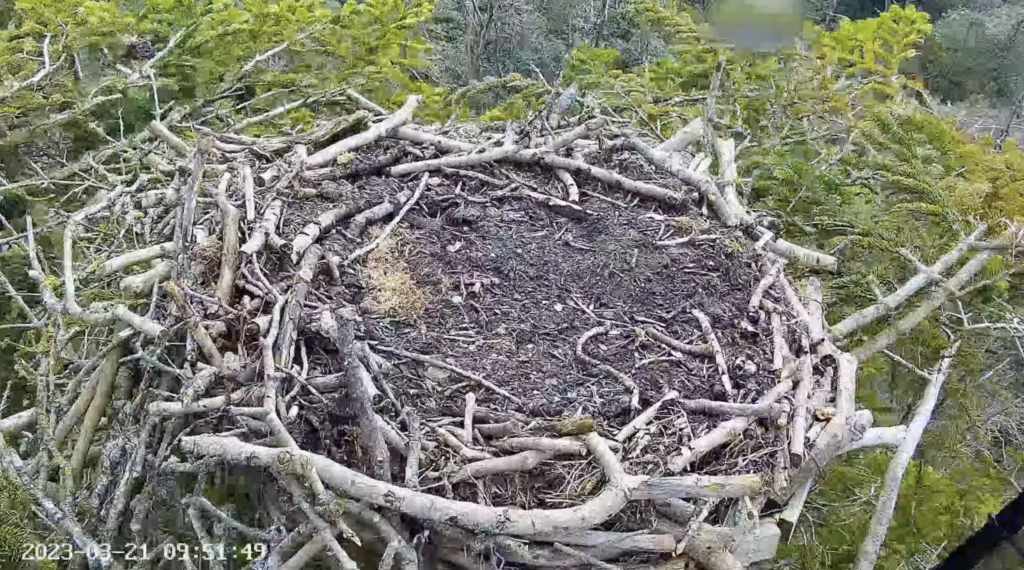
Having completed a successful breeding season at this nest site we expect that (all being well) CJ7 and 022 will return to breed here once again later this month or in early April. With this in mind, we wanted to make sure that if and when they do return, viewers are able to experience the best possible views of the pair through all the exciting moments milestones that come throughout the spring and summer. To cater for this we’ve worked hard to make some major system upgrades. Firstly, this year, there isn’t just one camera but two! Last year’s camera has been repositioned so that it looks straight down into the nest, whilst a brand new second camera has been added, providing a more scenic landscape view. Secondly, and best of all, we now have sound! This will make such a difference to the story this year, not only allowing us to hear the social and interaction calls between CJ7 and 022, including him ‘skydancing’ way above the nest, but also to capture the amazing moments when the chicks start calling and food begging. And so everything is now in place for what we hope will be a brilliant 2023 season.


Original 2020 & 2021 nest-camera update

A large part of managing Osprey nest sites is not only monitoring the general Osprey activity, but also looking out for any changes in behaviour and evaluating any future risks. In 2020, just as lockdown kicked in, many of us were transfixed and absorbed in the beginnings of CJ7’s story and her efforts to try and establish as a breeding female. This saw her take up residence on her original nest at another site within the Poole Harbour area, which also had a webcam on it. As lockdown progressed more and more people began tuning in, watching CJ7 as she patiently waited for her mate to arrive back. Sadly, he never did and CJ7 spent the rest of the summer touring the harbour, occasionally visiting the nest site, idly waiting for the days to grow short, before she then left on migration in late August. The following spring she returned, and met her now mate, 022, on May 18th 2021. The pair quickly settled on the original nest, and although 022 was too young to breed that year, hopes were raised the pair would develop their bond during the summer and return the following season to make an attempt. During 2021, the original nest camera provided a fascinating insight into the pair bonding between CJ7 and 022, seeing them even make several celebrity appearances on multiple online programs and TV news channels.

Throughout this period we visited the original nest site many times to observe the birds and also had a security device installed close to the nest, to log and record any disturbance issues. Despite the birds’ initial liking for that site, it soon became obvious that there were a number of general trespassing issues at that particular location. We think that this was a key determining factor in the pair abandoning the original nest site in late summer 2021 and settling at their new site in 2022. Despite our pair ‘moving house’ we were keen to know if the original site was still suitable for another pair to potentially settle at in the future, so we continued monitoring there during 2022 and unfortunately logged a few more incidences of general trespassing. The conclusion was reached that this was not a safe site to encourage Ospreys to breed at, and so this winter we made the tough decision to decommission that nest and camera. In the meantime, we have been looking for a safer location nearby to build a replacement nest, and the good news is we think we’ve found an even better spot on the same estate and are now liaising with the landowners with the hopes of rebuilding a nest here this coming autumn. We know that many people particularly loved the original nest and camera, and like us will have many fond memories of watching CJ7 and 022 (plus the Bourbon/Kit-Kat/Doughnut hiding Ravens!) on there and will be sad to see it go. However, we hope you’ll understand and share our view that the provision of safe nesting sites for Ospreys in Poole Harbour and ensuring their overall wellbeing must be our ultimate priority. We hope that being able to watch our pair continue their story via the exciting new camera setup will more than make up for this though, along with the knowledge that they may soon be joined by other birds establishing on the alternative nests we continue to put up around the harbour. Let’s not forget that this year we could see the return of some of our young Ospreys from the 2021 cohort return to the UK for the first time, and the Poole Harbour Osprey family will hopefully continue to grow with another year of translocation planned for this summer!

We can’t wait to watch the season unfold on the new cameras along with you all, here’s to hoping for the safe return of CJ7 and 022 in the coming weeks!

Osprey chick 5H2 update

Posted on: August 8th, 2022 by Birds of Poole Harbour

Following our update yesterday, we sadly received the news that juvenile Osprey 5H2 passed away this morning whilst in veterinary care. After sustaining injuries during a predation attempt made by a juvenile Goshawk on Friday evening, 5H2 was located by the Birds of Poole Harbour team and taken for emergency care at a local veterinary centre. She was then transferred to a specialist vet on Saturday morning where she received antibiotics and treatment to prevent infection in her injuries.

Despite given the best care possible, she died this morning due to those injuries, which in truth, was always the more likely outcome, but her resilience and strength over her final few days made us believe that there was at least some hope.

Thanks to everyone for their messages of support for the project, this is indeed a knock back for the season. However, when you place webcams on wild birds nest there will inevitably be scenes of nature that play out in their fullest that may shock or disturb. But these are just the realities and challenges wild birds face, including large birds such as Osprey. Since the predation attempt there have been no further signs of the Goshawk, so we assume it’s moved on. But it’s important to remember that the Goshawk, a magnificent species in its own right, was only doing what it knows best, which is to be the most efficient hunter it can be. We hold no animosity towards this young Goshawk, and just see the incident as unfortunate. Goshawk have been heavily persecuted over many years and are trying to make their own recovery which seems to now be coinciding with the return of the Osprey. And while we can’t rule out any future predation attempts again, the fact that Osprey, Goshawk, White-tailed Eagles, Peregrine, Marsh Harrier and Red Kite are now all visible again over Poole Harbour sky’s shows that times are changing and attitudes towards all raptors are improving.

Massive thanks to ‘Vets Now’ in Wimborne for 5H2’s initial care on Friday evening and ‘Anton Vets’ in Andover who cared for 5H2 over the weekend.

Thanks everyone for your support and sweet dreams ‘5H2’ x


Update on Juvenile Osprey 5H2

Posted on: August 7th, 2022 by Birds of Poole Harbour

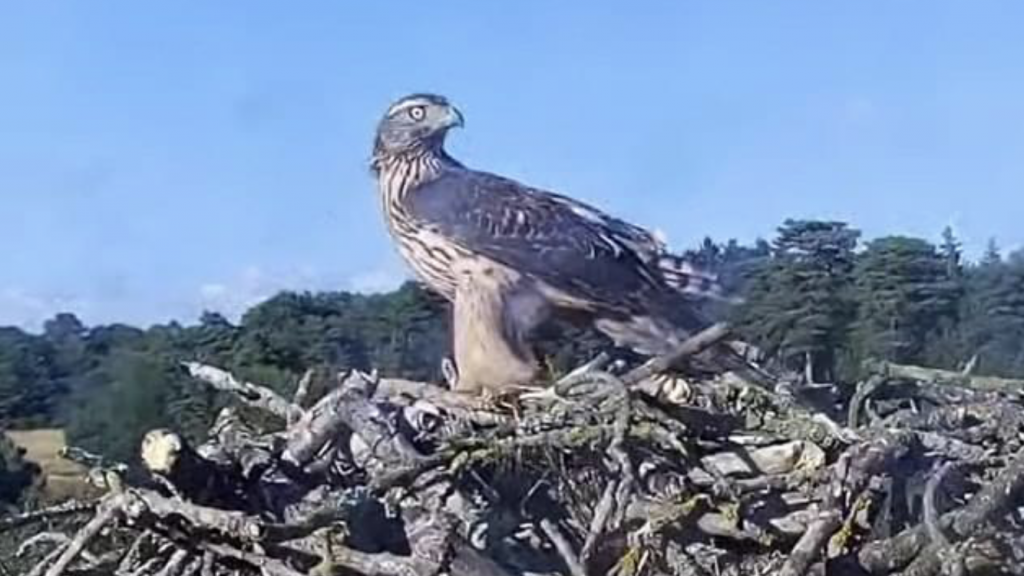
It’s been a busy and difficult last 36 hours, but we wanted to provide a quick update for everyone on the condition of the younger Osprey chick 5H2, who was unfortunately at the receiving end of a predation attempt by a Goshawk on Friday evening. The juvenile Goshawk first put in an appearance on the webcam at around 18:30, before returning to the nest again at 19:40 and making an attempt at 5H2.

Despite CJ7’s impressive reaction to the Goshawk, our team were concerned for 5H2 and reacted quickly, locating her on the ground near the nesting tree. She had sustained a considerable wound to her flank which required attention, and so was collected and cared for at an emergency vet over Friday night, and transferred to a specialist vets on Saturday morning.

Currently, 5H2 is still in a stable condition in veterinary care, where she is being closely monitored. She has been administered antibiotics and pain relief for the muscle damage to her left flank, which will require further assessment and ongoing medical attention. In spite of the seriousness of her injury, she has been consistently alert and bright-eyed, which has provided some reassurance to our team. We will keep you updated when we have further information on her condition.

Juvenile female Goshawk seen on the webcam on Friday evening

The Goshawk is also known to have survived, but seems not to have returned to the nest site since the incident: hopefully deterred by CJ7’s reaction. It’s very important to remember that Goshawk have been historically persecuted, just like the Osprey, and have only begun expanding their range in recent years. The individual in this case appears to have been a juvenile female dispersing from their nest, which may have been local but could be somewhere much further afield. Goshawk are formidable hunters and natural predators of other young raptors such as Ospreys, but should not be demonised for their behaviour and recovery in a landscape when they have been wiped out. We hope that the events of Friday were just a one off with a juvenile trying its luck, but we have still put in a few mitigating measures on the site and are closely monitoring the nest, simply because of the importance of this particular Osprey nest in starting a new population. CJ7, 022 and 5H1 have all been seen since Friday, with no further Goshawk activity reported so far.

We want to say a huge thank you to Tim Mackrill, who has been providing fantastic support since Friday evening, our volunteer Jon Pollard who was monitoring the birds at the time and provided invaluable information to us, as well as the vets who have been helping us since Friday. Thank you all for you kind words and support, we’ll continue to update you as and when we can.

Poole Harbour Osprey Chicks Fledge!

Posted on: July 27th, 2022 by Birds of Poole Harbour

The two young Ospreys, which are identifiable by coloured leg rings “5H1” & “5H2”, took to the skies earlier this week at just over 7 weeks of age. It’s been nearly two centuries since Ospreys fledged from a nest in southern England, with the last known breeding attempt taking place in 1847 on the Somerset Levels. Since 2017, Birds of Poole Harbour and the Roy Dennis Wildlife Foundation have been working to restore a breeding population of Osprey to the South Coast through a reintroduction project. This spring saw initial success for the project, with first breeding attempt made by Ospreys ringed CJ7 and 022. CJ7 went on to lay 3 eggs in late April, 2 of which hatched in early June. Since then, viewers have been eagerly watching the chicks develop through a livestream webcam. Both chicks are believed to be female due to their large size, with measurements taken during the ringing process in July. The video of the ringing of the chicks can be watched here. As the weeks progressed, the chicks could be seen preparing for flight, strengthening their muscles through regular wing flapping.

5H1 strengthening her wings for flight

The eldest chick, ringed 5H1, then fledged on the morning of Saturday 23rd July after days of making short hovering flights above the nest. She spent much of the day making short flights around the nest site, regularly coming back down to the nest and the surrounding perches. Webcam viewers then patiently awaited the fledging of the younger chick, ringed 5H2, which took place on Monday morning. Both chicks are now flying well and will continue exploring the nearby local area until they get the confidence to range further from the nest site.

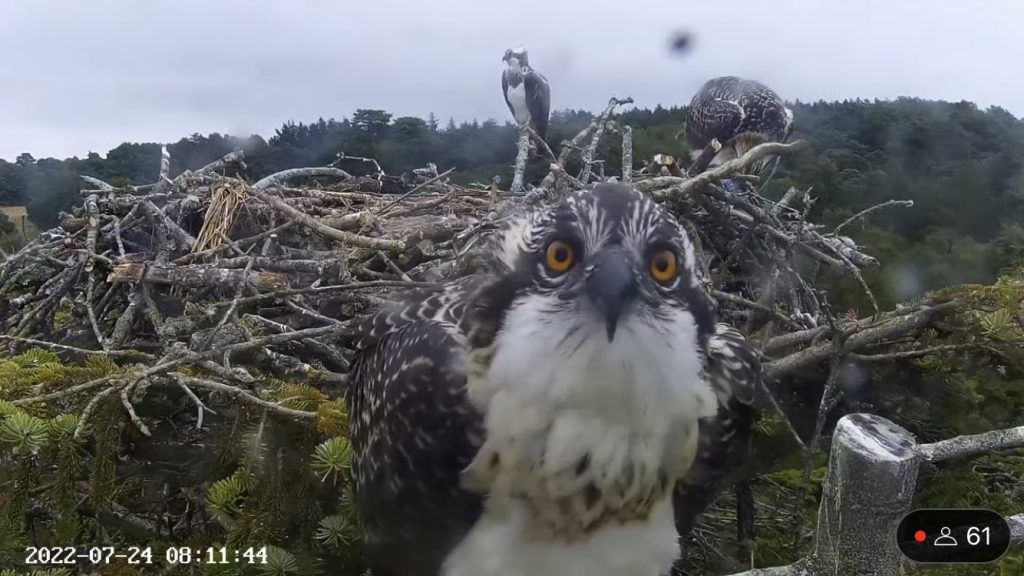
5H1 giving the webcam watchers an upclose view!

It will still be another 4-6 weeks before the young birds make their first migration, typically travelling 4000km to West Africa to countries such as The Gambia and Senegal. As they continue to strengthen their flight and prepare for migration, they will still be provided food by 022, the adult male, who will bring fish back to the nest for them. As first-time parents, 022 and the female CJ7 have done a fantastic job of raising the two chicks, provisioning for them well and protecting the nest from any unwanted visitors.

Liv Cooper, Projects Coordinator for Birds of Poole Harbour, commented “This is truly a momentous occasion. It’s fantastic to see the hard work that has been put into restoring this species to its historical range finally coming into fruition. There’s still a long way to go to ensure that a sustainable and resilient population of Osprey continues to grow on the South Coast, but seeing these first steps has been a privilege.”

Activity on the webcam is likely to continue into September, so the charity recommends still tuning in to see the latest developments. They are also running a series of 30 Osprey Cruises through the last two weeks of August and early September, ready for peak passage of Ospreys moving through Poole Harbour on their migration. Dates and tickets for the cruises can be found here.

5H1 making a quick landing on Saturday 23rd July

First Poole Harbour Osprey Chicks Ringed!

Posted on: July 4th, 2022 by Birds of Poole Harbour

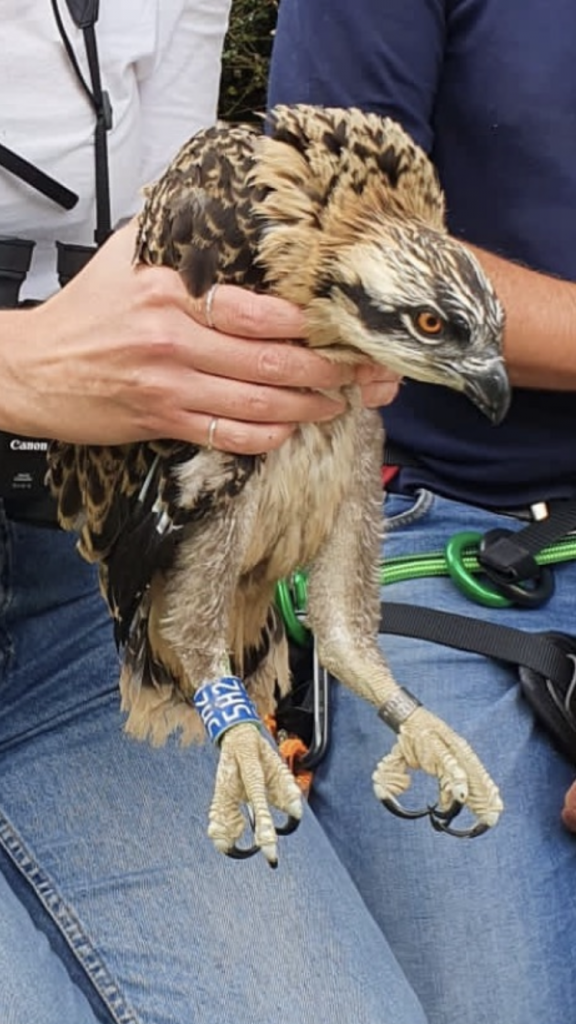
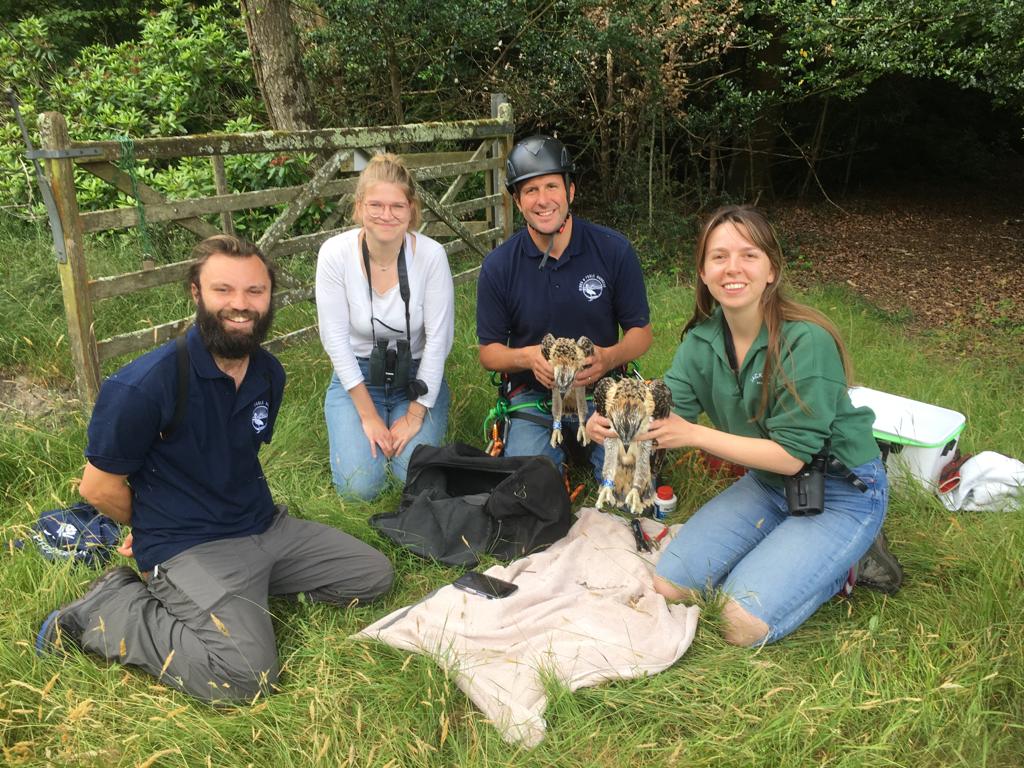
Just like their parents and other Ospreys ringed in the England, our two chicks were each fitted with a metal BTO ring on the left leg and a plastic Darvic ring on the right leg, with the codes ‘5H1’ and ‘5H2’ for the eldest and youngest respectively.

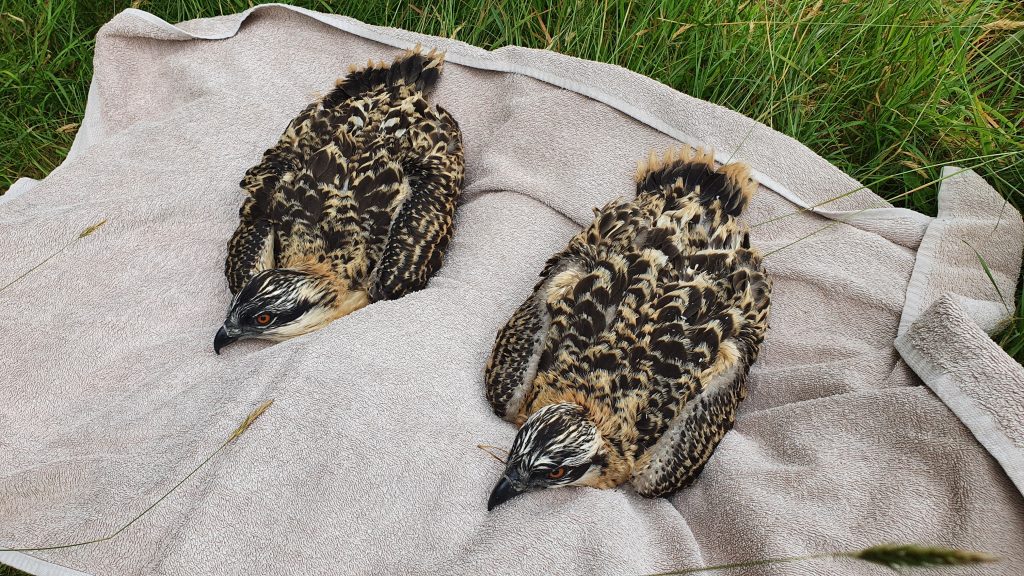
It was immediately evident that our two chicks were in excellent condition and developing well as soon as they were in the hand. At 4 ½ weeks old the chicks were at the lower end of the target age range for ringing (generally 4-7 weeks old), so still retained some of their downy fluff and many of their true juvenile feathers are still developing. Despite being young however, both were very substantial in size, weighing in at 1.6kg and 1.5kg. In conjunction with their overall size and build, this leads us to believe that both chicks are female, though this is difficult to be certain of at such a young age. It is something we may be able to confirm from their behaviour post-fledging, but will not be absolutely certain of until they hopefully return as adults in two years’ time.

The two Poole Harbour 2022 Osprey chicks, 5H1 (left) & 5H2 (right)

A single egg also remained in the nest, confirming our suspicions that the third egg of the clutch never hatched. This is not uncommon for first time breeders: those of you following the success of our young female 014 during her first breeding season in Wales last year will remember that only one of her three eggs hatched.

CJ7 circled overhead throughout the process, keeping a close eye on proceedings. Meanwhile 022, who was off site hunting when we arrived, returned shortly after the chicks had been replaced in the nest carrying a slightly meagre fish which was nonetheless gratefully received by CJ7 and the hungry chicks. Given 022’s absence since the previous evening, as a precaution we additionally added some locally sourced trout to the nest when alongside the chicks to ensure they would be well nourished after their excursion.

We are especially grateful to Fraser Cormack, whose exceptional climbing abilities brought the chicks securely down to the ground and safely returned them to the nest within just 30 minutes. The safety of the birds is always paramount in all of our work and a great deal of planning went into making this a smooth process. One key consideration for many conservation projects at present are the risks of the transmission of Avian Influenza (Bird Flu). In this case, where a single nest was visited in a currently zero-incidence area, we were comfortable that there was no risk of transmission and happy to proceed in line with BTO and government guidance.

Our translocation project on the other hand, relies on visiting of multiple nests in quick succession in a much higher risk area in Northern Scotland, and movement of collected chicks to Poole Harbour. Given the present uncertainty surrounding the risks and the apparent spread of the virus, we have concluded that it would be irresponsible to go ahead with our Osprey translocation project this year. Not only could it risk the lives of the translocated birds and introducing the virus to the local area, it could also risk the safety of our breeding pair and their two wonderful chicks. Seeing them successfully fledge and eventually leave on migration to West Africa later this summer is our ultimate goal and this is where we will continue to focus our efforts for the rest of the summer.

Birds of Poole Harbour team with the two osprey chicks

It was a real privilege to be able to carry out the ringing today and we’re thrilled to be able to share the details of this momentous occasion with you all. We were prompted, as during many milestones this year, to reflect again today on the ongoing support the local and online communities has provided to us and how this would not be possible without your generosity and enthusiasm. Thank you for being with us on this journey so far and we hope you look forward to following 5H1 and 5H2 as they make their way into the big wide world!

CJ7 and 022: Incubation and Identification

Posted on: May 20th, 2022 by Birds of Poole Harbour

The average egg incubation length for Ospreys is 37 days, though it generally ranges between 36 and 40 days. The hatching of their eggs is staggered, as with laying, but this can be affected by a behaviour referred to as delayed incubation. This is where the pair will reduce the initial incubation of the first egg to limit its development early on. This can bring the hatching times closer together, sometimes resulting in a less significant size and development difference between the chicks. In the first few days after hatching, this can be beneficial in helping the younger chicks get their fair share of food, as even a day’s difference in age is noticeable.

022 on the nest with CJ7 in the background

As potential hatching draws closer, incubation on the nest is going well, with 022 frequently relieving CJ7 from her incubating duties and spending a considerable amount of incubation himself. They’ve now got their changeovers down to a fine art, swiftly swapping who is incubating and making it more difficult to keep track of activity. Without being able to see their leg rings, we have to use other means of identification to monitor their behaviour. There are common differences between male and female Ospreys that can be useful. For instance, females can be up to 30% larger than males, having a bulkier body shape in comparison to the slenderness of males. With the right perspective, we can see the size difference between CJ7 and 022, but it’s not always obvious with the perspective that the camera offers. Females also tend to have a darker breast-band than males, as well as darker underwing patterning. This is also not often visible on the camera, with the birds tucked down in the nest to incubate the eggs. We therefore identify them most frequently using their head and facial markings.

Comparison of CJ7 and 022’s head markings

Over the last few years, many of us have become familiar with CJ7’s appearance. Her head markings are relatively well-defined and clean cut, with a notable “eyebrow” and central band of dark feathering leading up her forehead. Her facial features therefore appear quite pale on the camera, and, if you use your imagination, she has a square appearance to her head shape. It’s  also been noted by keen webcam watchers that CJ7’s eyes are brighter than 022, appearing more lemony yellow, whereas 022’s  are darker.

Comparatively, 022 has much darker facial features than CJ7. His forehead is heavily streaked and mottled, with intricate brown feathering extending further back up to his crown. Also noticeable is the prominent pale band beneath his eyes, which are deeper and extend closer towards the beak than on CJ7, which is surprisingly easy to spot at a glance. His head shape appears rounder and smoother than CJ7’s, giving a more oval impression than square.

It’s not always easy to see these features on camera, so we’ve put together these illustrations as a general comparison of the pair’s facial markings. Take them with a pinch of salt as they won’t be 100% accurate, especially as their facial feathers are easily moved and displaced, but they offer a guide to what you are looking for when watching the camera.

As always, thanks for reading and watching. Our next Q & A will be on Monday 23rd May, from 10-11am on the live YouTube chat, so we hope you can join us then! For now, we are looking forward to the end of the month, and hoping that CJ7 and 022 continue to keep up the great work of protecting the nest.


Project Success: 3 Translocated Ospreys Now Breeding

Posted on: May 10th, 2022 by Birds of Poole Harbour

We’re incredibly pleased and proud to report that this season there are now three of our translocated Ospreys breeding and incubating eggs! Of course, only one of these nests is in Poole Harbour (or indeed England!), despite the main aim of the translocation project being to restore a breeding population on the South Coast. So what’s going on?

The translocation project is underpinned by a key behaviour that many birds display, know as natal philopatry. Put simply, natal philopatry means that the species is generally attracted to settle and breed in their natal area, often as close as possible as to the site they themselves hatched from. In migratory species like Ospreys, this is facilitated by their ability to imprint on (i.e. memorise and form an attachment to) their local area, which appears to occur after fledging and prior to leaving on migration for the first time. Through translocation, and by moving young birds before this period, we can manipulate this behaviour so that they are inclined to return to the area of their release site, rather than the area of their natal nest. This behaviour tends to present most strongly in male Ospreys, though plenty of females also show an inclination to return to their natal site. But, at the other end of the spectrum, some females disperse enormous distances, and two Poole Harbour translocated females, 014 and 019, have done just that…

014 and Z2’s chick, Blue 494. Credit to Darren Moore

Last year, we were delighted to report that 014 was the first translocated Osprey from the project to raise young: a single male chick, which was ringed Blue 494. For those not familiar with the story, 014 was released in Poole Harbour in 2018 and was first reported back in the UK in May 2020. We were delighted to hear of her return, though slightly surprised that the report had come from our friends all the way over at the Dyfi Osprey Project in West Wales! Over the next few months, she continued to make herself known in different areas of Wales, exploring potential territories (which is very typical of young Ospreys), and even ventured down to Devon for a brief period of time. The South Coast clearly wasn’t her cup of tea however, as she was soon back in Wales, and frequently being reported with at least one young male in tow.

It came as no surprise, therefore, that when 014 returned from migration in 2021, she made a beeline straight for Wales. She set up on a nest only a stone’s throw away from the Glaslyn site at Pont Croesor, with a young male (Z2) known as Aeron, who fledged from Dyfi in 2017. The fact that the new pair raised a chick together was momentous. It meant that our project was already beginning to fulfil some of its wider, more longterm aims, in creating a link between populations in Wales, Poole Harbour and Rutland. Excitingly, 014 and Z2 are back at their nest at Pont Croesor again this year, and we are very pleased to hear that they are incubating eggs. Without a camera on the nest yet, we are unable to know how many eggs are in the clutch, but time will soon tell.

019 and KS6 (Dinas) on their new nest. Credit to Darren Moore

The success in Wales doesn’t stop there, however. On Monday 9th May, we were absolutely elated to hear that a second Poole Harbour translocated female, 019, has also settled on a Welsh nest with a young male, and laid her first egg! The male is KS6, another Dyfi fledged male from 2018, known locally as Dinas. This is the first breeding attempt for the pair and it comes after an interesting couple of years of sightings of 019, both in the UK and in her wintering grounds.

019 was one of the females released in the 2019 cohort of translocated juveniles (along with 022!). During that season, she was certainly a late bloomer, being the last to reach milestones throughout the project, including flight within the pens, fledging and leaving on migration. She therefore appeared to have defied the odds when she was reported in The Gambia on the 24th December 2019; an early Christmas present for the team! We were pleased to hear that she had settled in Gunjur Quarry, which is a fantastic area to choose for her wintering grounds, perfect for hunting alongside dozens of other overwintering Ospreys. Since then we’ve received regular reports of her from The Gambia, providing insight into the other side of these birds’ lives.

Hopes were therefore high for 019 to return to the UK in 2021, and she did not disappoint, arriving back in early June. But, just like 014, she was first reported in Wales, this time putting in an appearance at Glaslyn. It was great to see her back and looking in excellent condition, and bizarrely within minutes of 014 and Z2’s nest. We had a sense of déjà vu and anticipated that this would not be the last time that 019 was seen in Wales. Fast-forward to 2022, and after putting in a first brief appearance at Llyn Brenig in North Wales on May 19th, here we are, with the fantastic news that 019 is incubating on a nest with KS6, on another Friends of the Osprey nest in the exact same valley as 014 and Z2!

So, why are these females turning up in Wales? As we previously mentioned, the imprinting bond to be drawn back to their release site is weaker in females than in males (though there are exceptions there, too!). Both Dyfi and Glaslyn are on a perfect migratory flyway for birds returning to and exploring the UK for the first time. When they reach Wales, another behaviour also comes into play, referred to as conspecific attraction: Ospreys are attracted to areas where a population already exists. Happening upon the Welsh nests would have given both 014 and 019 the impression that the local area was a productive site to find a nest and a mate, and later raise young. It also doesn’t hurt that there are so many surplus bachelor males in the growing Welsh population and plenty of available nest sites thanks to conservationists putting up new artificial nests. So it didn’t take long the two females to settle in Wales, and we shouldn’t be too surprised by this movement. Indeed, it was a very similar situation that caused CJ7 to be attracted to Poole Harbour, having fledged in Rutland. With an abundance of translocated juvenile Ospreys greeting her arrival in 2017, it was easy for her to be convinced that the area would be an excellent place to raise young.

All the pieces are therefore in place for the long-term success of the project, both with the nest in Poole Harbour paving the way to establish a new population, as well as connections being formed with Wales and Rutland. We couldn’t be happier or more proud of what has been achieved so far, and we’re extremely grateful for the teams across Wales and West Africa for their work and their updates on the translocated Ospreys. We can’t wait for the rest of the season to unfold, and will be following the progress of all three of our birds with avid excitement!

022 and CJ7 inspecting their first egg, now one of three being incubated

Call 01202 641 003