We hope you enjoy this next topic and have been enjoying learning about Ospreys so far. As usual, you can find the full PDF download here: World Osprey Week Migration
Tomorrow we will have another new topic, so remember to check back in!
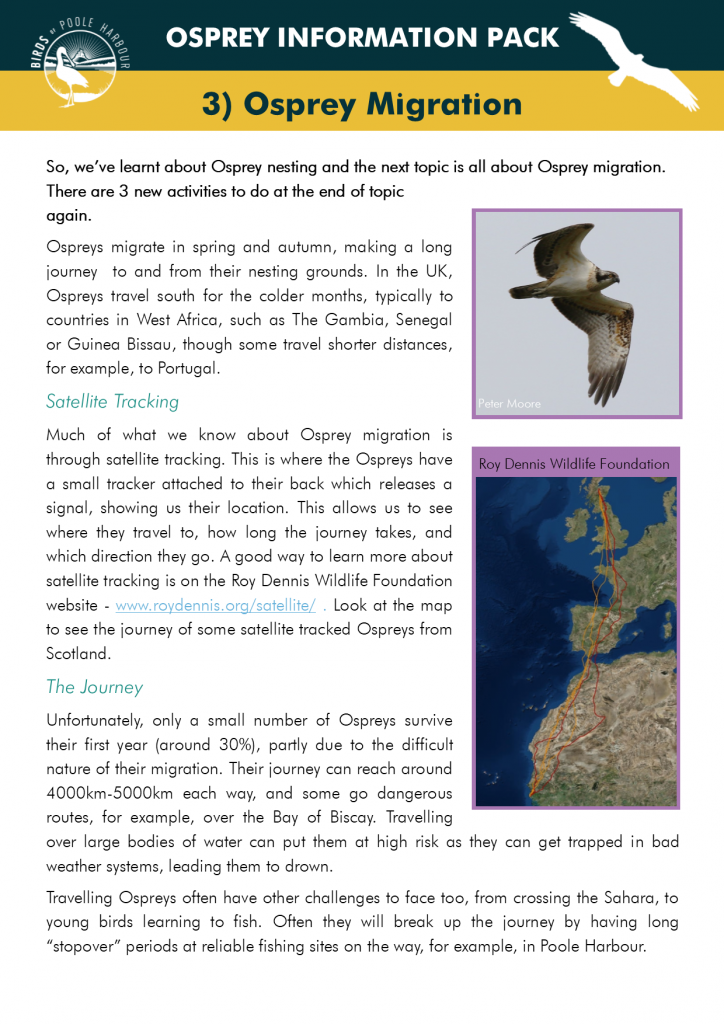

We hope you enjoy this next topic and have been enjoying learning about Ospreys so far. As usual, you can find the full PDF download here: World Osprey Week Migration
Tomorrow we will have another new topic, so remember to check back in!
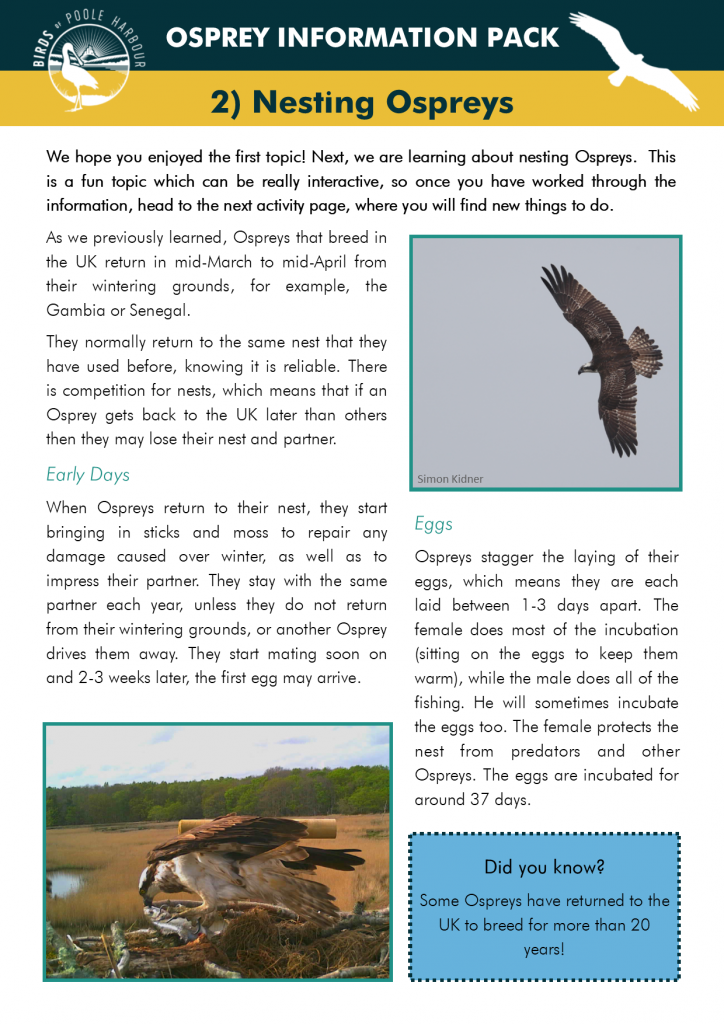
It’s World Osprey Week (23rd-28th March) and, while schools are closed, we want to use the opportunity to increase education about Ospreys and the Translocation Project, through providing material for families to use at home. Each day this week we will post a new topic, along with activities to make the learning more fun.
Let us know if you use the materials, what you learn and whether you see any Ospreys on our webcam. Follow the link to download the PDF for Osprey Learning Day 1: World Osprey Week Introduction
We hope you enjoy!
On January 19th 2020, Birds of Poole Harbour organised and conducted the Big Poole Harbour Bird Count which was to provide the public with an opportunity to get out and explore their local patch whilst collecting important data which would be used to provide a snapshot of bird species diversity, species totals and species distribution across the Poole Harbour area on a single day during the winter. Poole Harbour is nationally and internationally important for a whole range of species during the winter with many birds arriving from thousands of miles away to seek refuge here during the colder months.
Slavonian Grebe – Jerry’s Point – Ian Ballam
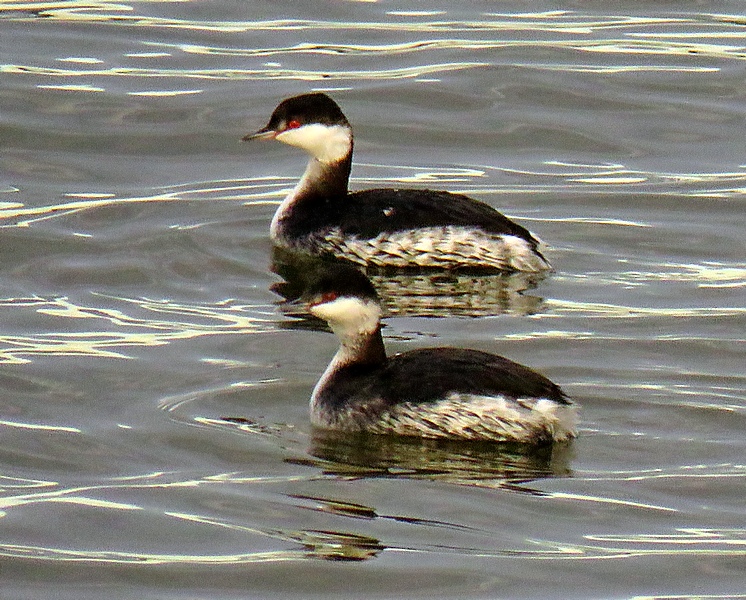
On the day of the survey, the weather was certainly on side as winter sunshine beamed down across the harbour and a light northerly wind softly cooled the cheeks of each of the participating members of the public. The survey also coincided with the monthly Poole Harbour WeBS (Wetland Bird Survey), which is an important survey managed by Birds of Poole Harbour and carried out by 31 BTO (British Trust for Ornithology) volunteers which see’s every single water bird in the harbour counted each month during the winter to monitor over-wintering populations.
The ask was simple…..if you were out birding that day, we wanted to know what you saw, how many you saw, and when and where you saw it. Then, with that data we would be able to analyse and asses totals of each species based on when people saw different birds and where they saw them.
Now, after a few weeks of getting our head around the data we’re able to provide you with the final counts and totals from the records submitted to us from the survey.
The Purpose : Although this data only provides a snapshot of bird populations on a single day, it’s hoped that we’ll be able to host this event as an annual survey from now on, and like any long term data set, we should be able to note population and range changes over time. Plus, it also allows us to note which species are under recorded/represented and perhaps need a special survey focus in the future to gage true populations, for example Water Rail, Jack Snipe, Woodcock etc.
Background
Spring 2018 saw Birds of Poole Harbour open its engagement headquarters on Poole Quay. The information hub is a focal point for our work and an information rich environment for visitors to learn about the harbour and its birds. Founded in 2013, the charity aims to raise the profile of bird conservation, preservation and observation in and around the Poole Harbour area. The harbour benefits from national and international protection and to date has hosted 331 bird species. Boasting a diverse mosaic of habitats, the Poole Harbour basin offers excellent birding opportunities throughout the year. Our HQ offers visitors an in-depth insight into how to ‘bird’ the harbour and showcases our various projects. The centre is also a small retailer of optics, books and postcards.
Reports to
HQ Manager, Birds of Poole Harbour Trustees
Duties
The Engagement Supervisor is expected to:
Person Specification
Full training will be provided for this role including till usage, visitor engagement roles, optics display and display usage/maintenance.
Personal Attributes
Skills
Knowledge
Contract information
Salary: £8.72/hour
Full-time and part-time positions considered. Weekend work required.
Contract: Fixed Term – May to September
Closing date: 29 February 2020
Who to contact?
If you are interested in joining our team, please forward your CV together with a covering letter by email (PDF files only).
Send application details to:
Joe Parker
Those of you that have been following our work for a number of years now will know about the nocturnal migration work we’ve been carrying out since 2015. At night, throughout the year, when we’re all in bed, many thousands of birds migrate across the night sky, their presence only given away by the calls they make to one another as they move from A to B in the darkness. Now, these movements may only involve short local movements that birds like Barn and Tawny Owls make or it may be long distance movements like waders, thrush’s and terns make. Regardless of the distance covered, many of these birds call at night and its only now that we’re getting our heads around what species do move at night and just how many there are.
Since 2015 we’ve been pretty obsessed with learning about this topic, so have been deploying sound recording equipment at night at sites we think birds will be travelling through. After a nights recording we can then analyse and listen to the recordings to find out what species have been passing over that very night. Interesting recent discoveries have including the discovery that Ortolan Bunting, a rare passage migrant in Dorset is actually a regular night migrant over Dorset sky’s each August and September. Also, each October and November, vast numbers (thousands) of Redwing, Song Thrush, Blackbird and Fieldfare are passing over Poole Old Town during the dead of night. We also record lots of waders, all of which migrate long distances at night, as well as a few geese and tern species too.
Forever wanting to learn new things, we recently approached the National Trust Purbeck team about the possibility of setting up our sound recording equipment at night within the high grounds of Corfe Castle. The reason for this is because we’ve long assumed that ‘the Corfe Gap’ is in fact a migration route in and out of Poole Harbour for many birds as we often see finch, hirundines and pipit migration through there in the autumn. But what goes through there at night?
With kindness and enthusiasm the Purbeck NT team said yes to our hair-brained idea, so this summer and autumn we’ll be carrying out night recording sessions from within Corfe Castle its self….HOW COOL IS THAT!
What have we learnt already?
In prep for the autumn, which is the busiest time for bird migration we’ve recently carried out three tester recording sessions (two in late May, one in early June) and have already discovered something quite interesting. It seems some local water birds are using the Corfe Gap as a short cut to other water bodies close by, with Moorhen, Water Rail and Little Grebe all being logged in our recordings flying over Corfe Castle at night. In one of our May recordings we also logged Dunlin and Knot flying past distantly, suggesting already that some waders are using this route as a short cut to the harbour.
Little Grebe – Call of night migrant through the Corfe Gap 30/05/19 @ 23:10
Water Rail – Call of local bird moving at night – Corfe Castle 09/06/19 @ 23:01
Moorhen – Call of local bird moving at night over Corfe Castle 10/06/19 @ 02:19
Also, its been discovered that the local Tawny Owls have been successful as we’ve been hearing calling juveniles in our recordings. And who can ignore the eerie call of the Barn Owl which seems to be calling frequently around the castle with it’s rasping screech giving it the old nickname The Demon/Devil Bird.
Barn Owl – Call of local bird flying through the Corfe Gap – 31/05/19 @ 23:35
With so much heard already in just our first three recording sessions, its hoped the peaked months (Late July to late October) will turn up some more exciting surprises.
On a warm, sunny May evening I wondered over to the Puffin boat after a day’s work in the Birds of Poole Harbour HQ. It was nice to see a gathering of likeminded birders all queuing up, waiting to alight the boat.
The trip was the first out of three sold out Puffin cruises, so we did not know what we were going to expect. With six o’clock approaching fast we alighted the boat and sat ready to go. The first few birds were recorded: Cormorant, Great-black Backed Gull, Black-headed Gull, Herring Gull and Oystercatcher. The latter sat on a nest near the quay sea wall.
Then, to my amazement a group nearer the front saw a Bottle-nosed Dolphin just off the quay swimming south. This individual was more than likely the lone individual from Portland who likes moving between Studland and Swanage. His name is ‘Danny’ and has become a local celebrity with his own Facebook page and many eager fans. Unfortunately, I did not see him.
After an introduction by Paul Morton and Mark Constantine as well as health and safety by the skipper we started the cruise. Jake Blade and I, both Engagement Assistants in the BoPH HQ, were spotters for the evening. We started the cruise by heading towards Brownsea Island to view the Dorset Wildlife Trust’s lagoon. Instantly, we saw Sandwich Terns and Common Terns both leaving their breeding grounds to feed out in the harbour as well as two Little Terns who were first picked up on the webcam earlier in the day. Six Avocets were loitering on the mud with a single individual sat on a nest, an iconic Poole Harbour species. Other birds present included the seemingly resident Shelducks, Gadwall, Black-tailed Godwits and Grey Heron as well as a small flock of migrant Dunlin which included a Knot.

Arctic Skua chasing Common Tern
Our cruise continued, I pointed out multiple Sandwich and Common terns to the public as we headed out of the harbour entrance and into Studland Bay. A migrant Arctic Skua was picked up by Paul as it darted across Poole Bay. It started to chase and harass the local Terns as it gave an amazing display beside the boat.
Just before we left the BOPH boundary, a flock of Guillemots and Razorbills passed distantly and members of the public gained nice views of a Peregrine, two Fulmars, a Gannet, Kittiwake and the local Cormorants around Old Harry’s rock. Paul mentioned how Cormorants are persecuted throughout the United Kingdom and how this may be affecting the local population. Surprisingly, a Little Egret flew high North headed towards Poole Harbour and a flock of House Martins circled the cliff tops near Ballard down.

Kittiwake – Blackers Hole
A very informative chat by Paul and Mark as we headed past Swanage and Durlston about a range of topics including the breeding sea birds. Along this section of the coast we saw large flocks of Guillemots and Razorbills as well as a small population of cliff nesting Swifts and twenty-four Kittiwakes. At this point we were closing in on Dancing Ledges and people eagerly looked out for the Puffins.
Just past Dancing Ledges we had success! We saw five Puffins mixed in with the other auks and were provided with prolonged views of the flock for a long time. This was the highlight for many people on the boat as this species was a new for them.

Puffin – Dancing Ledge
After some breath-taking views of the Puffins, we headed back along the coast. The evening chill picked up but allowed a nice sunset over the harbour mouth as we passed Old Harry Rocks. The only new bird seen for the trip was a Mediterranean Gull before having one last look on Brownsea Lagoon and alighting back on Poole Quay finishing around 21:00.
All in all a stunning trip and here’s looking forward to the next one!
Since Birds of Poole Harbour began in 2012, we’ve seen a wonderful rise in interest and support for our work right across the harbour. Our various projects and research have seen us working with private landowners, tenant farmers, BCP council, RSPB, National Trust and the Dorset Wildlife Trust and its through these progressive partnerships we’ve been able boost the profile of bird conservation, preservation and observation in and around Poole Harbour.
Now, we’re thrilled to be announcing a new partnership with Osprey Packs, a world leader in outdoor and all weather terrain rucksack and backpacks. By some kind of amazing coincidence, their European head office is here in Poole, where of course, it just so happens we’re carrying out our Osprey translocation project, in an effort to restore a south coast breeding population right here in Dorset. Osprey Packs have kindly offered to tell our story to their international customer base and we’re hoping that within a few years Osprey will be breeding right here in Poole Harbour, providing an exciting story to tell.
Below are a few words from our new partners and we look forward to seeing this relationship grow as our Osprey project develops over the coming years.


On a beautifully sunny Saturday morning I board the busy boat and find a seat for the 8am sharp departure. With Safety procedures covered, Paul starts his commentary as we swiftly motor out into the harbour to start our 3.5 hour tour. Paul gives us an outline to the organisation, some history to Poole harbour and some information about current bird life in the harbour and what we might expect to see. Freshly arrived spring migratory species and Osprey are at the top of our list!
As we make our way towards the mouth of Wareham river we get our first spot from Ian Ballam, another local, on board, expert. A majestic Sandwich Tern flies past the boat having arrived in the harbour recently on its migration. Paul gives us a few tips to identifying different tern species and goes on to give some invaluable information about the best local sites to see Osprey over the coming months.
The next spot are a group of late winter leavers, a group of Brent Geese flying in a ‘V’ formation over the boat. An unusual species for this time of year as most have already left the harbour heading to cooler climate of Siberia on their migration.

Some Mediterranean Gulls join us off the back off the boat as we head closer to a small set of islands where they now breed. With a quick bird ID tip from Paul we could then tell this species apart from the similar, more common relative, the Black Headed Gull, which we also see flying above us. Paul goes onto tell us about an interesting and disturbing event that happened a couple of years ago which involved the illegal collection of these birds eggs and how BoPH played a crucial role in putting a stop to this poaching.
As we head past Fragmites’ Reed beds, the largest in Poole Harbour, we can see a large number of juvenile Mute Swans hanging out together at their ‘youth club’. Paul goes on to inform us of the threat to the reed beds from the invasive Sika deer grazing and how this has impacted bird habitats across the UK in a number of ways.
With our eyes still pealed for the illusive Osprey, we are fast approach Wareham river and some Greylag Geeseand hear the distinct call of a Whimbrel, before we see it rush past us. Paul gets a small round applause following an informative display of various bird calls that we may hear within the reeds of the river banks as we enter the river. Slowly we come across a variety of calls from warblers and Paul points out the key differences between your Sedge and your Cetti’s Warblers. As we move along the warblers calls get more frequent, giving us a good opportunity to practice our call identification skills that Paul had advised us on. A reed warbler then added his call into the mix, which totally threw me, as a slightly less experienced birder on the boat!

As we passed a large open area of water within the reeds we spotted a group of Tufted Duck and10 Great Crested Grebes, diving for food. A raven then flew alongside the boat, a species that you may be surprised to know drastically dropped in number but has since made a steady recover.
Paul points out some paths in the surrounding area that are some of the lesser known about locations for spotting birds, with hints and tips to where and when to go to tick off some of the ‘must see’ species.
As we approach Ridge Warf we continue to hear the call of warblers around us and an additional species, a Willow Warbler is pointed out by Paul. In the surrounding fields we see a couple of Curlew surrounding by a group of resting Whimbrel. As we approach Redcliffe Sailing Club we see some of the first of the seasons Swallows speedily swooping across the water. One has landed on the top of the mast of boat directly ahead of us, giving us a lovely view of it as it takes into flight as we pootle past and ponder about the toilsome journey the swallows have completed before their arrival.
As we approach Wareham Quay we pass some more urban species such as a Great tit, House Sparrow and a Starling before everyone goes soppy at the site of a group of small Mallard ducklings!
Heading back up the river we see a pair a Jay’s following the boat before they land and Paul points out the majestic song of a Skylark and identifies a lone Reed Bunting, singing at the top his voice as he sits at the top of a bush. As we pass Ridge Warf again we see a small group of Gadwall bobbing up and down as the drift along.
We pass some jet black Cormorants chilling out on a gate and a group of chatty Oystercatcher with their distinctive red bill and quirky call.
As we creep out of the river we find ourselves passing group of feeding Sandwich Terns, as one dives into the water at high speed it then re-emerges and takes flight as it gulps down a large, tasty Sand Eel right beside us, providing a fantastic photo opportunity for those with a quick trigger finger?
As we head around the to Arne, Paul gets a frustrating report of 2 Osprey over the Wareham Channel (where we just came from) only minutes ago, so we all up our game and keep a watchful eye on the skyline as we head back in that direction, on our war to Brownsea Island. We pass a group of Black-tailed Godwits in their vibrant rusty summer plumage as they hand out at the back of the marsh.
The sea is stunningly crystal clear as we approach Brownsea and Paul fills us in on some its interesting and colourful history. As we come in close to the lagoon we have an excellent view as we cruised slowly passed. A lone Spoonbill sat with its head down as in amongst a flock of Black-Tailed Godwits. A group of 10 or so Avocets gracefully linger along in the shallow water. Paul informs us that these few remaining individuals, who haven’t migrated with the other flocks, may stay throughout the summer months and breed. The first Common Terns have arrived to enjoy plentiful food after their long journey and a flock of Grey Plover are not what they seem as Paul’s eagle eye spots a couple of Dunlin and single Knot in amongst the crowd. Our last spot of Shelduck, Shoveler Duck and a Grey Heron bring our spectacular trip to an end as we turn and head back to the quay.
Paul rounds up the trip by highlights the importance of the support we receive from the public and how these bird boats not only enthuse people about the birds we are lucky enough the see in Poole Harbour but also go along way to supporting the projects that we run.
Although we weren’t lucky enough the to spot the illusive Osprey this time, we saw a wonderful variety of over 34 bird species out in the harbour today, showcasing what an Internationally important habitat we have here on our doorstep and highlighting how important it is that protect this stunning sites for not only birds but our next generation to enjoy.
If this has inspired you to book onto one of our bird boats or bird walks please check out our website to get more information and book a trip. Alternatively pop into our HQ on the quay where our friendly staff will always be on hand to answer any questions and help you find a trip that will suit your needs.
© 2026 Birds of Poole Harbour Registered Charity No. 1152615