
Welcome back to the Poole Harbour Osprey Diary! With CJ7 and 022 both returning safely back onto their nest on the 25th March at 18:29 and 26th March at 06:40 respectively, it’s been all go ever since! There’s been lots of nest-building, fish deliveries, and plenty of mating. 022 returned back to his old ways, bringing some black plastic onto the nest, mistaking it for nesting material. Thankfully this has been taken away each time and, in the last few years, has not caused issues for the eggs or chicks. We monitor the webcams and site closely 24/7 for occurrences like this. We’ve spoken to landowners locally about removing black plastic from their land, but with the Ospreys travelling several miles to collect nesting material, it is a difficult task to reach all potential sites.
We are thrilled that at 12:56 this afternoon, CJ7 laid her first egg. Eggs tend to be laid 3 days apart, with delayed incubation until the second or third egg is laid not uncommon. This is where the pair will delay the initial incubation of the first egg to limit its development early on. This can bring the hatching times closer together, resulting in a less significant size and development difference between the chicks.
With the pair back for their fifth breeding year, having produced 13 chicks since 2022, we’re wishing them another successful season. There’s lots more to be excited about, with hopes of 5H3, a male chick from the 2023 Carey nest that returned back to the harbour last year (and showed interest in Lancashire female 6C6) for the first time, coming back and potentially pairing up with any roaming females. We’ll also be awaiting to see if any of the 4 chicks from the 2024 Carey nest (5R0, 5R1, 5R2, and 5H6) which were all male, return back to the harbour. 2 year-olds tend to arrive back a bit later in May/June time, as they do not reach breeding age until 3 years old. They’ll spend the summer looking for potential females and nest sites for the following year. We’re also pleased to say that female 1H1 and Poole Harbour translocated male 374, the second pair of Osprey to breed in southern England for over 180 years last year, have returned safely back onto their nest. On top of that, 5H1, the female chick from 2022 (the first year CJ7 and 022 bred), has returned back onto her nest in the East Midlands, where they bred for the first time last year and produced 3 chicks, with her mate Rutland male 3AY!
We’ll be updating this Osprey Diary throughout the season, sharing key moments, sightings from the Osprey Viewing Platform, and any interesting behaviours.
Diary Entry 13/09/26
This will be the final diary entry of this Osprey season. It’s been a very quiet week on the nest apart from some hopeful Magpies… On Friday 4th September both 022 and 6T8 were still around at Carey although 6T8 seemed to getting less noisy and demanding. In the early evening 022 brought her a whole fish. She had to put up with a bit of pestering by the Magpies and she flew to the camera pole. 022 flew off and was not seen all the following week and it was assumed he had left. The following morning 6T8 appeared on the camera pole. She seemed to be disturbed by something and flew off. This was the last time that she was seen and it is assumed that she has at last departed . It was thought that 022 had migrated about the same time. However he was observed from an Osprey Cruise boat in the Harbour on 12th September. That is 10 days later than he left last year. We don’t know if he returned to the nest as the camera was down for several days. However the camera is back now so he may come back to it before he goes but probably not.
This weekend saw the final Osprey Cruises of this season. There are still at least 3 Ospreys around the Harbour. One of the 2024 youngsters 5H6 has returned after his roamings. The Tweed Valley female 6J8 and Carey youngster 5R0 have been seen on another Harbour platform. The Kielder Forest juvenile 2B9 is still being seen having been here almost a month and 3 Ospreys were seen flying through the Middlebere Channel on 13th September. The final Osprey /Eagle Ham Common Pop -up session will be looking out for some of them on 15th September. So with 022 likely to depart in the next few days, we have come to the end of a very successful Osprey season. Another four chicks successfully raised at Carey and the second Dorset nest (nest site 2) producing another 3 chicks. Even more important is the increased interest in these beautiful birds and how they have made more of us see how important our natural environment is to us and them. We await next spring with the prospect of increasing the number of nests in the harbour, awaiting the return of the juveniles from 2025 and seeing if the interaction between the 2-year olds who returned this year results in another Osprey success story.
Kielder Forest juvenile 2B9 – RSPB Arne Saline Lagoon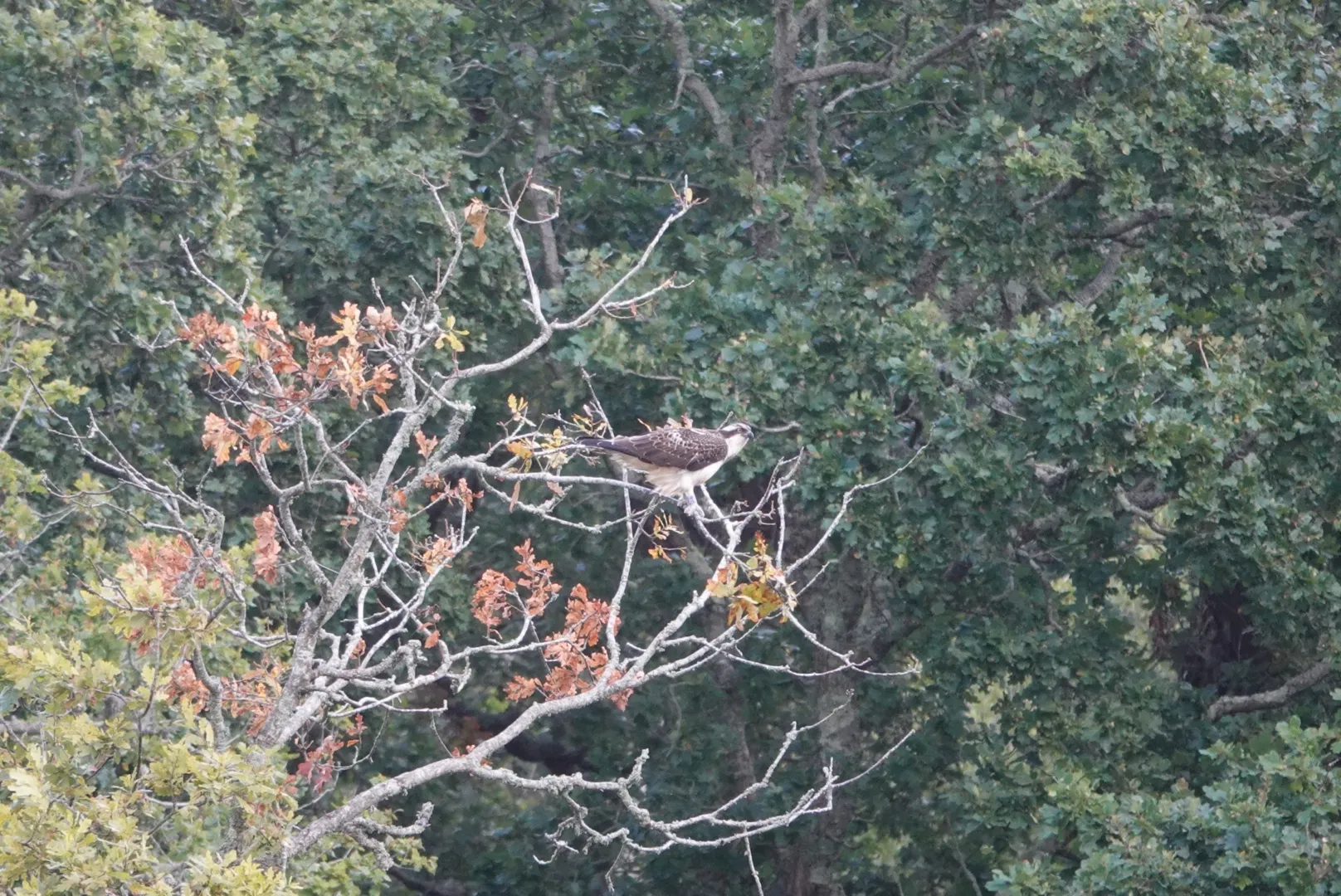
Diary Entry 03/09/26
So, we are very much moving towards the end of the Osprey season for this year. However, we do still have our juvenile female 6T8 collecting fish delivered to the nest by 022. It is 47 days since 6T8 fledged on 19.07.26 and according to Nest watch, she has taken a total of 67 fish so far and since the start of the season 022 has delivered a total of 205 whole fish and 259 partly eaten fish. In 2025, 022 was last sighted in the harbour on 02.09.25 and as this date has passed the question is when will 6T8 and 022 depart on their journey South? 022 is following the pattern as with most breeding males in the UK of leaving after the last juvenile has left and, in the UK, some breeding males do not leave for migration until the end of September, often several weeks after the adult female has left.
Before leaving they will tend to put on excess weight for the challenging journey and it is likely that they will pause to feed before, during or after a day’s flight. Our adult Ospreys CJ7 and 022 having migrated both North and South several times are likely to have their favoured spots along the routes for their stop offs. The juveniles however will encounter their own areas to stop off, and some may linger at such places, but some may not so the timing of the Carey’s youngsters’ journeys may be very different. They could be travelling to Western Africa or even perhaps only as far as the Iberian Peninsula and Portugal as in more recent years there have been increased sightings of Ospreys over wintering in these areas. Some UK Ospreys have been recorded (using tracking data) to travel more than 5000 + kms to their wintering grounds.
The rest of the harbour is experiencing a lot more activity still and the favoured spots tend to be the Wareham Channel, Lytchett Bay and South of the harbour with one day evidencing over 12 Osprey Sightings. CJ7 was last spotted from an Osprey Cruise on 28.08.26. Interestingly, there have been regular sightings of an unringed female who seems to have settled in her favourite spot at the South of the harbour; it looks like she has been present for almost a month. The Tweed Valley 2 year old female 6J8 still continues to be seen on nearby platforms along with Carey’s returning male 5R0. Let’s hope this pairing continues and that they return to Poole next season. 1H1 the
breeding female from Poole’s nest 2 has been sighted with a juvenile fishing in Christchurch harbour on several occasions this week whilst a Kielder Osprey 2B9 has been seen fishing at Arne.
Diary Entry 28/08/26
This may well be the penultimate entry to the Osprey Diary as migration is well underway and we already have the probable departure of two of our Carey Osprey family. Poole Harbour has been full of Ospreys this week with people on our Osprey Cruises seeing up to 10 birds on a trip and plenty of fishing attempts. And of course with so many Ospreys in the harbour, the opportunist White-tailed Eagles (from the Isle of Wight translocation project) have been seen busy chasing the Ospreys to get them to drop their fish (kleptoparistism).
The Carey nest has become increasingly deserted as the week has progressed. Even the Magpies are not visiting so often although if a juvenile turns up, calling for food, they still appear. Last Saturday (22nd), 022, CJ7, 6T6 and 6T8 were all seen on the nest together with 6T9 turning up a bit later. By the end of the week this was a rare sight. Unfortunately the cameras have been off on a few occasions due to technical difficulties so a few sightings may have been missed. Most noticeable has been CJ7’s absence from around the nest. With her youngster guarding duties at an end and no intruding Ospreys coming to steal the nest, her only duties are to contribute to the feeding. She seems to have even lost the urge to get sticks for the nest. By this time last year she had already left so once the weather is right she will probably depart. However at the beginning of the week she was seen feeding 6T9 so obviously had not lost her mothering instincts. She was seen fishing in the harbour at the end of the week. The most action has been from 6T8 who seems to have the loudest voice and the greatest appetite of all the juveniles. She has also been seen to be increasingly aggressive, chasing off the other juveniles particularly 6T6 who has not been allowed, to land on the nest if 6T8 is there. As a male, he’s smaller so more vulnerable. As well as the urge to migrate, there is also a strong urge to stock up with body fat for the journey ahead so this may be fuelling 6T8’s aggression.
As already mentioned, two of our juveniles are believed to have started their migration. The eldest bird, female 6T7 was last seen on 21st August at 05.44 . There is no sure way of knowing whether a bird has migrated but thanks to the cameras, most feeding taking place on the nest and local observers it is assumed that if a bird has not been seen for 24 hours, it has departed. It was several days before another bird was missing. 6T6, a male, the next eldest was last seen at 19.00 on 26th August being chased off the nest by 6T8. The change in the weather may delay departures but it will certainly be soon that there really is an empty nest and we will all be looking forward to seeing what the next Osprey season will bring.
It is certainly looking promising with so many juveniles having been seen in the harbour and interest in the harbour nest sites seen between the 2 year old Tweed Valley 6J8 and the 3 year old 5H3 from the Carey nest. There has also been an unringed female seen interacting with returned young males from the Carey nest. These birds will depart singly but hopefully will return safely next season and renew their bonds leading to more Poole Harbour Osprey families. For those who haven’t yet connected with these fascinating birds, there is still time to see them even when our Carey family have departed, as Ospreys continue to pass through the harbour for several weeks yet from various sites. This last week we have seen two birds from the Kielder project, a female 699 seen at Carey and a juvenile 289 fishing in the harbour. There have been also Scottish birds with 9J7 from the Borders among them. Some of these birds passing through will stay for a few hours and others, finding how good the fishing is, may stay days or even weeks. That is why the Poole Harbour Osprey Cruises continue for a few more weeks yet.
Diary Entry 21/08/26
Apart from the frantic fish delivery and collection all is quiet at the nest site for most of the time but there was the highlight of a Honey Buzzard visiting. This is completely different from the activity going on in the harbour. Interestingly, this week CJ7 and 022 have brought in an equal number of fish with 6T8 managing to grab most of them and 6T6 the least. Perhaps this is due to 6T6 being a smaller Male not needing so much.
There has been lots of excitement however across the whole harbour with possibly 12 different Ospreys being sighted as the migration season has well and truly kicked off.
Throughout this week our Carey’s Osprey family have been seen on several occasions with the youngsters flying with Mum and Dad watching, learning and practicing the essential skills they need to catch a fish. To survive the migration journey they must become adept at this.
So why do they need to migrate? Mainly because of a change in food availability where in our harbour as the autumn starts there are fewer fish available, and it becomes more difficult to catch those remaining. It is also believed that they need to migrate to reduce competition and predation. Birds breeding at higher latitudes may be unable to survive the colder, wetter and windier winters that are apparent during this season without moving South.
However, migration is not without risk, and they must undertake challenging journeys where those that go to Africa such as 019 a translocated Poole harbour Male that fledged in 2019 must negotiate the Sahara Desert, Mountain ranges and crossing large areas of open seas. The adults will always go back to the same place each year. Indeed, a female Osprey breeding in Wales for several years 5F, has been photographed on the same post at the same place over several years in Africa. Those regularly returning breeding Ospreys such as 022 and CJ7 will have conducted a similar journey every year for many years and are likely to have become very adaptive in dealing with such challenges and changes in circumstances which is evidenced by a survival rate of 90%.
This rate of success is not however experienced with the youngsters that attempt their first migration South and perhaps their next migration North where the survival rate is far less, reported at 30%. However, those young Ospreys fledged at Poole harbour are showing a much higher return rate of over 60%. Provided our Carey’s youngsters do survive this southerly migration they will need to establish themselves somewhere they can live for the next 2 years amongst a great deal of competition from other Ospreys breeding in other countries.
Reviewing her the past return dates, CJ7 should be due to be leaving anytime now but she will leave when the weather conditions are right. Generally, a North Easterly tailwind would be ideal. Like most males 022 will stay here to continue bringing in fish for the youngsters until the last one has departed and last year his last sighting in the harbour was 02.09.25.
Great news from the sightings is that 6J8 the 2year old female from the Tweed Valley continues to remain here. She seems to be spending most of her time with our returning 3 year old male 5H3. They seem to spend most of their time in the Southern part of the harbour on different nests and resting in the same trees although they have been seen venturing further North in the harbour. She appears to be quite a feisty female and has been seen chasing off a White Tailed Eagle again which bodes well for the future.
On separate occasions, 7T0 the Male fledgling from this year from Poole nest 2 has also visited the harbour as indeed has his father 374. Another exciting sighting has been 2B9 from the Kielder Forest who was spotted at RSPB Arne.
There seems to be a natural divide evolving between the Carey’s Osprey family who spend most of the time in the North part of the harbour and the other visitors that have spent several weeks in the harbour such as 6J8, 5H3, and an unringed female who spend most of the time in the South of the harbour. Perhaps this is the Ospreys defining their territories for next season.
This interesting shot taken by Mark Wright is perhaps the capture of the season which shows an Osprey diving in one direction and the fish going in a completely direction.
Osprey and fish – Mark Wright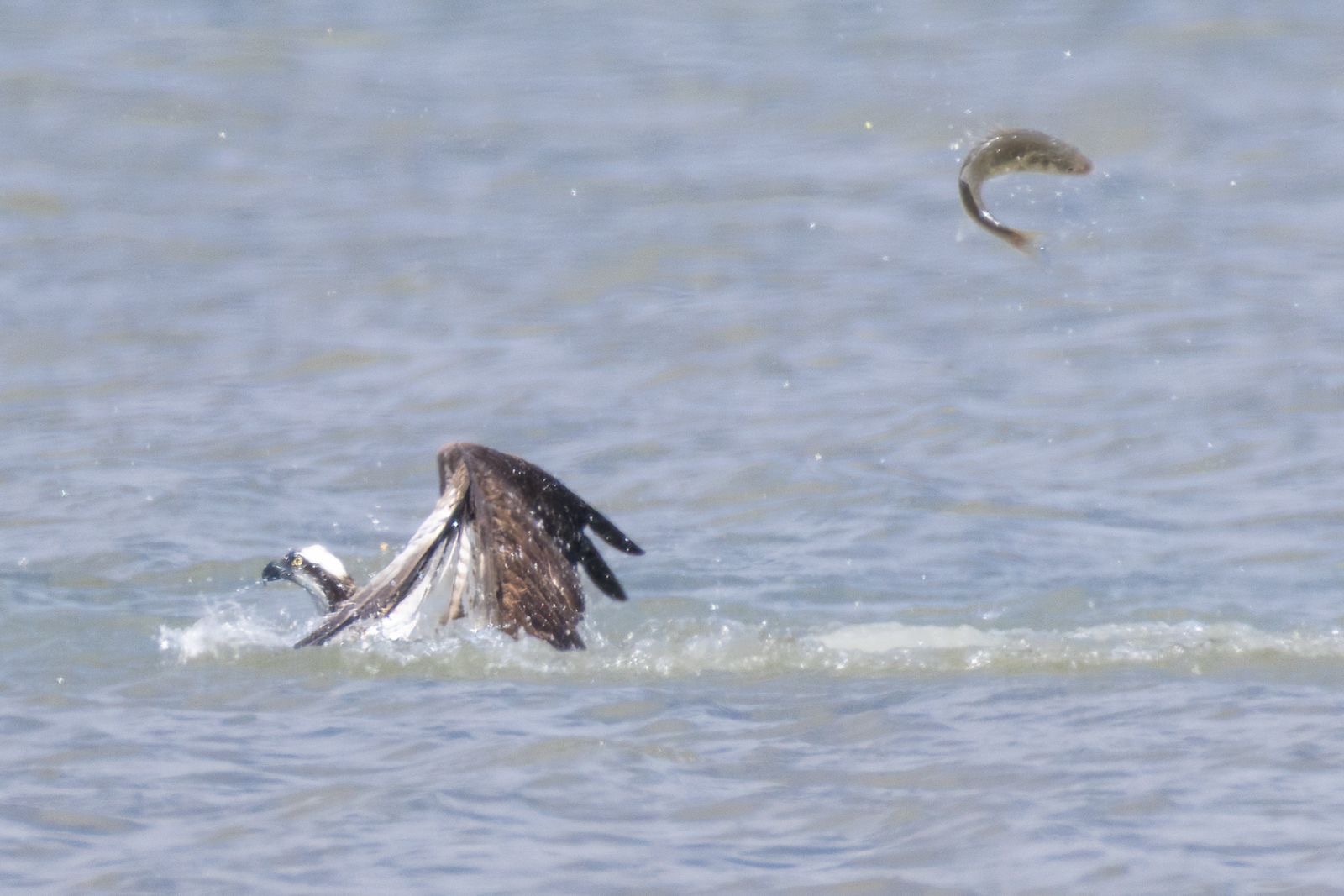
Diary Entry 14/08/26
This diary entry will be focussing more on what is happening in Poole Harbour than on the Carey Nest Site as the young Ospreys are spending more time exploring their wider surroundings and imprinting a map of the district for their return. However as they are still dependent on their parents for food they don’t go that far as they are mostly fed on the nest. Early evening seems to be when they often congregate to squawk for a fish supper. They do come back to the nest during the day if they’re hungry and a parent often obliges. They usually carry their prize off although 6T9 was on the nest eating a flat fish that CJ7 had brought. It may be that carrying a flat fish presents more of a problem for a juvenile Osprey.
Magpies continue to annoy the Ospreys, particularly CJ 7 who is still protective of the nest and continues to bring in a few sticks. A very cheeky Magpie was seen to tweak 6T8’s tail on one occasion so they are not welcomed . They do clean the nest though if no Ospreys are around in the harbour the Osprey Cruises began in midweek and there were frequent sightings of up to 7 Ospreys on the cruises . Friday was a particularly good day when there were 7 Ospreys in Wareham Channel including 2 of the juveniles from the Carey nest, the parents CJ7 and 022, a 3 year old Carey male, 5H3, the Scottish female 6J8 and the 2 year old male from Carey 5R1. An Osprey was also in Holes Bay on that day. 5H6 (known locally as Little Titch ), was seen in the Middlebere Channel carrying sticks to a platform. Later he was seen visiting the Carey nest where he grew up as the youngest of the first brood of 4 chicks and was the favourite of watchers on the live stream. However 6T8 wasn’t at all pleased to see him and he quickly departed. An unringed female has also been seen.
Migrants from more northern nests will continue to spend time in the harbour throughout the month and into September .There have also been up to 7 birds seen in the Middlebere Channel during the week. All this activity, particularly of the young birds, augers well for the prospects of other active nests in Poole Harbour in future years. The next hurdle in front of our Osprey family is migration, a formidable hurdle indeed. Although some Ospreys have been recorded over-wintering in southern Spain and Portugal, the majority of them head for West Africa which means crossing the Sahara Desert. Each bird migrates on their own with the juveniles having to find their own way. Most juveniles migrate 5-6 weeks after fledging so it could be next week that 6T6 departs with the youngest departing around the 27th August. These times are only possibilities as there can be quite wide variations. Factors such as weather, changes in day length and night temperatures can be factors. Unlike in other species there is no reduction in food provision. The only way we will know they have gone is when they don’t turn up for food. We can only wish them safe travels!
Male Osprey 5H3 – Mark Wright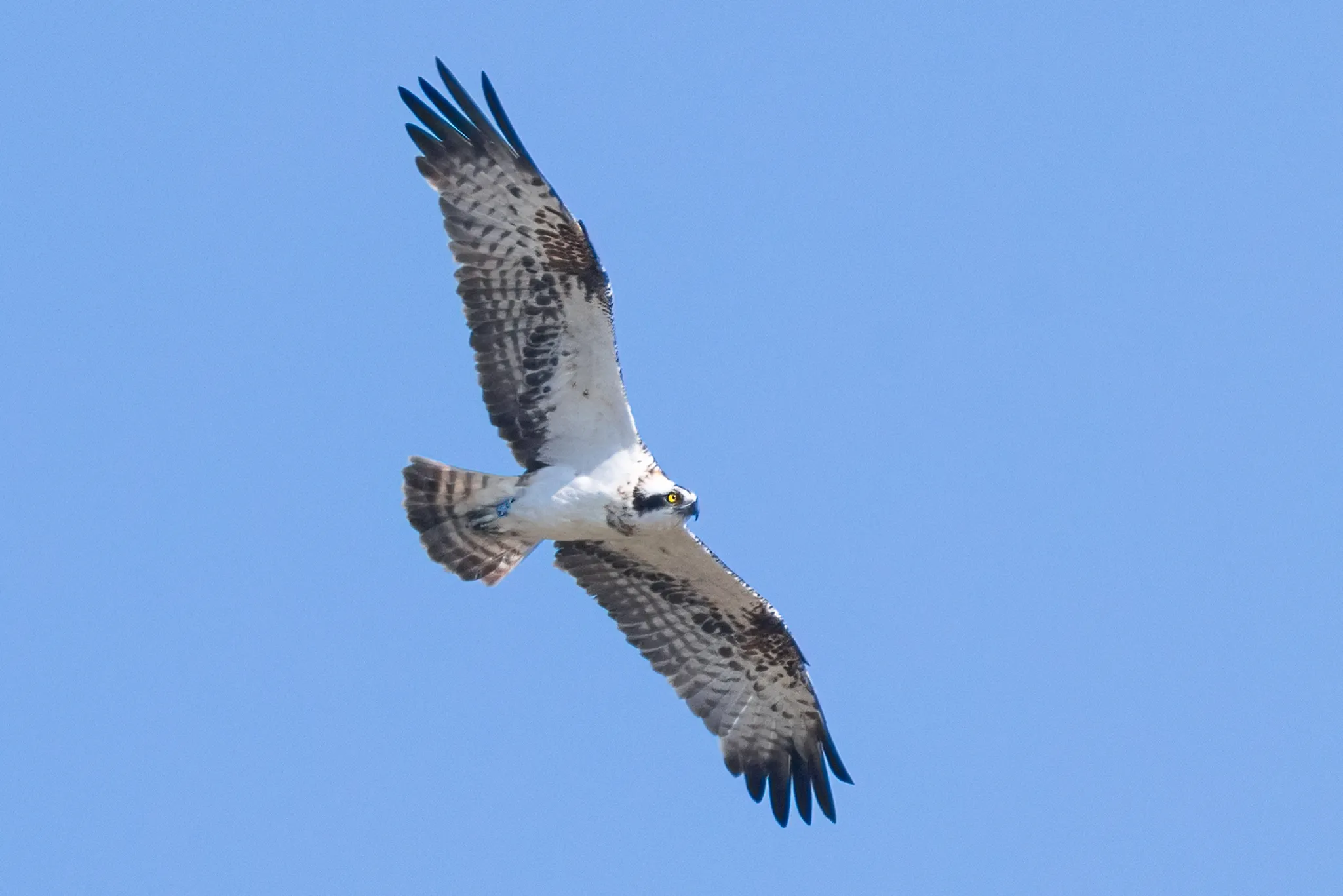
Diary Entry 07/08/26
Just another few weeks and it is possible that our Osprey family will have departed for their Autumn and Winter homes and we will no longer be able to follow their fortunes. This week has been uneventful which is good for our young Ospreys as they have just been doing what we expect them to do, improving their flying skills, exploring further afield and imprinting the area we hope they will return to in two years time. Their parents also spend more time away from the nest, fishing for their hungry family and building up their strength for their long journey after a season of parenting. With both parents fishing and the juveniles using more energy, the amount of fish delivered has been increasing with 12 fish delivered to the nest on the 7th. Mostly this sighting of them on the nest is very brief with the young bird grabbing the fish and quickly flying away with it. If there is more than one juvenile on the nest there can be a bit of a tussle. They all seem to be developing well and no bird seems to dominate.
The young birds have been seen attempting to fish and observing other Ospreys fishing but usually they don’t fish for themselves until they are completely independent and have started their migration. At the beginning of the week Osprey 6T6 from the Carey nest was seen practising fishing in the Wareham Channel by one of the Summer Safari Cruise boats. As well as our family, the Harbour is host this month to a number of visiting Ospreys who are passing through on their way south. They sometimes stay for a while as the fish are plentiful with one visitor staying into the first week of November a few years ago but that is unusual.
Our recent cruises have had good sightings of Ospreys with members of our own Osprey family seen and a number of the Ospreys passing through. At the beginning of the week watchers in Lytchett Bay observed an example of kleptoparasitism where three Ospreys were fishing and a White-tailed Eagle intimidated one to drop its fish. This mobbing of Ospreys by the reintroduced White-tailed Eagles has also been seen by visitors on the cruises, and will likely be seen more frequently as more migrants pass through the harbour. Among the Ospreys seen around the harbour, have been the young birds from the 2024 Carey brood, back for the first time and those we hope will extend the number of nests in the harbour. There have been possible sightings of 5R0 and 5H3, males from the Carey nest and the Scottish female 6J8.
CJ7 with fish from a Summer Safari Cruise – Brandon Storey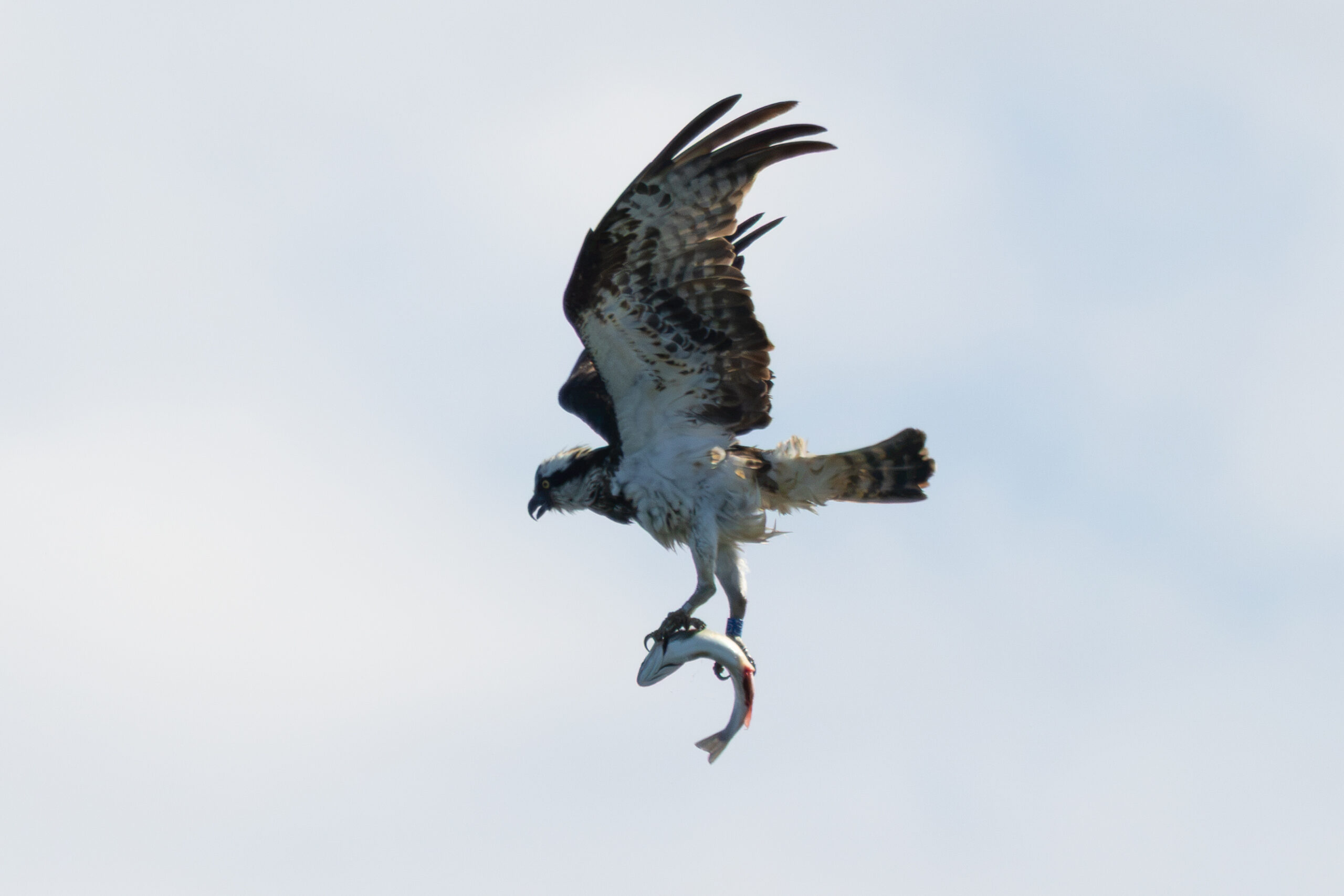
Diary Entry 31/07/26
Continuing hot and dry all week presented less of a problem than previously, as now the young Ospreys have all fledged they spend less time on the nest and can seek out a shady spot nearby to rest when they are not practising their flying. Arguably this post fledging period is the most important part of their development when they are building up their flying and landing skills and gaining the strength and endurance they will need for the long journey ahead of them. The young Ospreys do not venture far from the nest for 7 to 10 days after fledging. This has been evident this week when a parent brought a fish into a nest that was empty or with only one juvenile in it, very shortly all four juveniles would be there squabbling over the newly delivered meal. They had obviously been in the immediate vicinity. There were some spectacular tugs of war when 022 arrived with a flapping fish. Not only did the youngster have to detach the fish from 022 ‘s talons and then protect it from a sibling who also wanted it, they then had to control the flapping fish which threatened to flap itself out of the nest which has occasionally happened. A grateful fox may be getting an unexpected fish supper!
Eating the fish was the next skill to be mastered as up until recently they had been fed by CJ7 or occasionally 022. They always start at the head and it needs quite a bit of strength to pull off the gill sections and get to the fleshy bits. Gradually this week you could see an improvement in this skill. Occasionally a whole fish would be eaten by a single juvenile but mostly they would leave it as soon as they were full, another bird would take over or CJ7 would take control and feed any of the youngsters who were still hungry. With such a good provider as 022 with occasional supplements from CJ7 none of them seemed to go without. Later in the week all 4 juveniles were seen on the nest with a fish each. In the latter part of the week another skill was developing namely taking the fish from the nest to a favourite perch and eating it there where no siblings could attempt to steal it. The youngest 6T9 was seen helicoptering above the nest with her fish before deciding it was too difficult. Later she managed it as did others but mostly they were still feeding on the nest.
For those watching the birds on the livestream the most noticeable thing this week is either an empty nest ora very noisy one as it’s amazing how much noise even one hungry Osprey can make when it’s food begging. Add to that the noisy grating sounds of the Magpies who seem to turn up at the same time.
It’s interesting to see how protective CJ7 is of the nest still, chasing off any intruders and still bringing in sticks and nesting material. After 3 months of relative inactivity, she also has to build up her strength for the long journey ahead. She will migrate first, round about the third week of August, leaving 022 to finish the job of feeding the youngsters.
Our Carey Osprey Tours have now finished for the season! From now on it’s best to book one of the popular Osprey Cruises to get good views of this family and migrant Ospreys passing through, It is very rewarding that so many people have wanted to see the birds on the nest and learn about the lives of these fascinating fish eating raptors that have been reintroduced to the South of England. People on this week’s tours have seen the young birds in flight. On Thursday two of the youngsters were seen chasing off a Raven and harassing a Common Buzzard.
By the end of this week, on more and more occasions there would be an empty nest or just CJ7 there, showing the growing independence of the youngsters. Thursday night was the first night that there was no bird roosting overnight on the nest, just CJ7 on the branch. There have been quite a few sightings of Ospreys in the Harbour including an un-ringed bird thought to be female. Earlier in the week 5H3 was seen with an unringed female and 5R0 was fishing in the Wareham Channel. Hopefully that will mean next year there may be one more pair in the Harbour.
Diary Entry 23/07/26
Well, what an exciting week it has been in terms of Osprey activity in our beautiful Poole Harbour! So where to start….
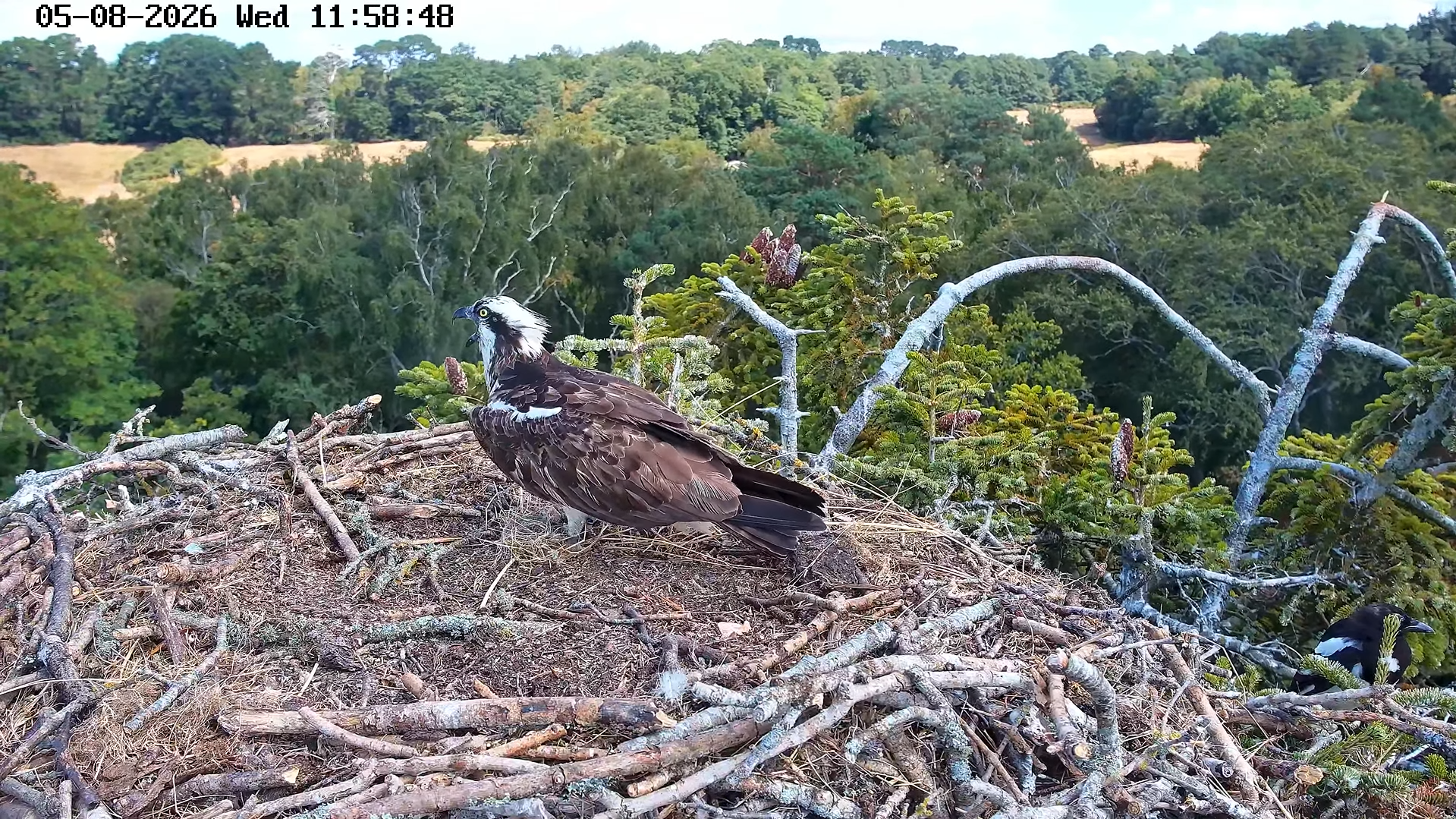
By the end of this week all four of our chicks have successfully fledged from the Carey’s nest site and this is the 3rd year running that this has happened; a great testament to the excellent parental abilities of CJ7 and 022. The Ospreys now need less protection from their parents as we have seen with CJ7 venturing further away from the nest and catching her first fish this week since she has laid her eggs to supplement the fish being brought in by 022. Ospreys have very large digestive tracts, more than expected for a bird of their size which enables them to take out the maximum nutrients and calories as the food passes through.
Our juveniles continue to stay relatively close to the nest as at this stage as remaining close to the nest increases their chances of obtaining sufficient fuel for their migration. It is likely that by August they will be exploring further around the harbour whilst they will still be very reliant on the food provision from CJ7 and 022. The post fledging period is the time for them to gain essential life skills where they will establish the behavioural skills and physiological changes necessary for successful migration. It is critical that they are well fed and in good condition to survive the long journey that they will be undertaking for the first time.
At the nest site there has been several intruding Ospreys during the week. On one day early this week as observed by a volunteer on site was a morning of great excitement. The action started at 09.00 when 3 Ospreys were seen approaching from the West, at this time 022 was coming towards the nest with a fish delivery and he was sky dancing. CJ7 started alarm calling with one chick on the camera perch and 2 others on the nest whilst 6T6 was out of view. There were 4 adult birds flying around occasionally coming very close to the nest. At about 09.11am an unringed female landed on the nearby branch and CJ7 was able to get her off with lots of wing flapping. Then 022 still with a fish was observed flapping CJ7 off the perch probably mistaking her for an intruder. For the next 15 minutes chaos ensued, with all the 5 adults flying around most of the time, accompanied with a lot of alarm calling. CJ7 then returned to the nest and continued to mantle until the intruders flew off to explore the rest of the harbour and feeding resumed at the nest. What a spectacle that activity must have been! The best news was yet to come.
It was later confirmed that a 2024 male that fledged from the Carey’s nest identified as 5R1 was seen later in the harbour. He could possibly have been one of the intruding Ospreys returning to his natal nest for the first time since migrating. This was great news as 3 Ospreys from that cohort (5R0, 5R1 and 5H6) have now been sighted back at their natal home of the harbour this season. This represents a return of 75% which is far above the return rate of 30 – 35% considered to be the norm in the Osprey world. Most juveniles will stay in their wintering grounds of West Africa but also Southern Spain and Portugal for 2 years before migrating North.
The Southern part of the harbour has still been experiencing a lot of activity too. Our Tweed Valley female visitor 6J8 is still favouring this area which is fabulous news. She was spotted on a BOPH boat trip but has also been seen spending a lot of time with our male 5R0 on a platform they particularly favour whilst also seen eating fish on another platform close by. 5R0 still continues to share fish with her but she has also been seen successfully fishing independently. On another BOPH boat trip, the guests were able to watch 5R0, CJ7 and 022 all hunting in the Wareham channel.
Over this part of the harbour there have been some unringed Ospreys seen which is great news and for a change to his normal fishing ground in the Wareham Channel 022 was spotted fishing in this area too, likely to be keeping his territorial eye on what is happening, also the regular sightings of an Osprey in Lytchett Bay still continue as do sightings of the local White-tailed Eagles.
Diary Entry 17/07/26
Another very warm week for the Ospreys which is less of an issue as they are all thermoregulating now. So what an exciting week it has been on the Carey’s nest this week!
With the eldest chick being about 8 weeks old, the youngsters are no longer putting on weight which explains why the daily fish deliveries from 022 have reduced to an average of 4. The desired impact of this is that the body mass of the birds reduces as they prepare for fledging.
There has been a lot of strengthening, wing flapping, and helicoptering and the first two youngsters to fledge have been 6T6 and 6T7. There is often confusion when fledging actually occurs; the general consensus is when it successfully takes its first controlled flight away from the nest or close by perches and is able to manage any wind currents without having any mishaps. It is suggested that the lighter birds (likely to be the males) fledge first. They will all generally stay close to the nest, gaining strength and developing their skills.
The chicks are all now self-feeding which is an amusing stage watching them have a “tug of war” over the possession of the fish. It is often a clamour to get the fish as soon as 022 delivers it if CJ7 doesn’t get there first. The youngsters will grasp it and mantle over it and tearing off bits of flesh but at this stage CJ7 is seen taking control of the fish to ensure that all the youngsters get fed despite getting pecked by chicks.
Around the rest of the harbour, there have been several sightings of other Ospreys this week. Last weekend an Osprey was seen mobbing a Honey Buzzard in the area whilst another one (possibly one of our other male adult Ospreys that have been in the harbour) was spotted that day. There also seems to be a regular sighting of an Osprey sitting in a dead tree in the Lytchett Bay area whilst others have been spotted in some dead trees near Middlebere.
At the start of the week an adult unringed female was spotted at the South end of the harbour which could possibly be an early migrant. On Tuesday, 022 was caught on camera at another nest platform where he was initially joined by an unringed female on the perch whilst a third Osprey was flying above them. 022 didn’t tolerate them for long and gave chase, being very territorial.
Another morning an Osprey was seen being mobbed by a Buzzard near to Middlebere whilst a distant Osprey was seen from a BOPH cruise.
Interestingly 6J8 who spent some time in the harbour with her following of males for several weeks was caught on camera sitting on the Clywedog main nest in Wales at the start of the week and then was seen intruding on the Clywedog second nest at the end of the week. It seems she hasn’t found a partner yet so we are still hopeful she will return here next year to maybe pair up with one of our boys.
Diary Entry 10/07/26
This week has been a relatively quiet one, no fledging yet but moving slowly towards that momentous occasion. Important but rather sad because this season seems to have sped by. However it’s still the most important part of their development moving towards complete independence and their first hazardous journey in the early autumn.
At the beginning of the week the wing flapping begins to increase particularly from the two older birds, 6T6 and 6T7. The flapping often brings a small storm of downy feathers which the birds are now shedding. On Saturday the breeze was a bit of a problem when the flapping lifted the bird slightly above the nest but it’s all part of the learning process.
Throughout the week 022 continued to be the perfect provider bringing in 5 or 6 fish daily with 7 on Tuesday, most of them of a good size. Any aggression amongst the young Ospreys at feeding time seems to have completely stopped with 6T6 seeming more interested in flapping and looking at her surroundings than feeding sometimes.
By the end of the week there were few attempts at self feeding, apart from picking up scraps, although on Friday, 6T7 relieved 022 of the fish, only for CJ7 to quickly take charge of it. This is another important strategy to be learned, because when the birds have fledged, they will come back to the nest to be fed and if there is more than one bird there, it will be necessary to grab the fish, mantle the wings over it and then fly off for a peaceful feed. It will be interesting to see how the young birds deal with Magpie interactions when they are feeding by themselves. The Magpies are still much in evidence with 6T7 being the keenest at attempting to chase them off backed up by CJ7.
By the end of the week, despite the heat, flapping amongst all the young birds had increased and helicoptering had begun. This is when the bird rises, hovering briefly above the nest and is when the first fledge can occur. However it needs a lot of practice and it is estimated that this may occur from the 12th July. Females tending to be slightly later than males due to their larger weight. CJ7 has continued to bring in sticks and bedding throughout the week. The birds particularly like standing on the edge of the nest, probably to get the best of the breeze in the heat although CJ7 is still trying to be an umbrella, mostly used by 6T9.
There has not been much news about the young returnee Ospreys exploring the harbour who we hope will provide a third southern Osprey nest. Possible sightings of two other 2024 Poole birds proved unfounded. Unfortunately the only female, Scottish 6J8 has been seen on the camera on a Welsh platform but it is hoped she will soon return to Poole Harbour to join up with one of our 3 lovely young male birds.
Diary Entry 06/07/26
All the chicks are well-feathered, have lost their dinosaur-like appearance, and are now looking like proper Ospreys. By the end of the week it is only the creamy edges to the feathers that distinguish the two older chicks from their parents on a quick look. The weather has been kind to them this week with temperatures going back to normal June levels. They are all standing well and throughout the week the wing flapping increases.
These chicks are extremely well fed by 022, regularly bringing in 5 or 6 fish a day and on one day last week he brought in 10 fish. Sometimes he eats the head before he delivers the fish but often it’s a complete fish that’s still wriggling. They are so well fed that on occasions there are fish laying uneaten on the nest although CJ goes back later and always clears up the nest. All of the young Ospreys are now picking up scraps and one of the older youngsters attempted to make a grab for the fish when 022 brought it in. Later in the day they are so satisfied that only one or two of them lines up to be fed.
Nest building is still going on. CJ7 frequently brings in large branches which she has to manoeuvre round the chicks to arrange to her satisfaction. They have to duck to avoid a whack with a branch! Occasionally she brings in greenery, small branches with leaves on as well as lumps of dried grass. Leaves and pine needles are thought to act as an insect deterrent.
Wednesday was the most eventful day of the week as ringing the chicks was arranged for early that day. It involved the ringer in full climbing gear, climbing the 30+ metre tree and putting the BTO metal ring and the blue Darvic ring (used for identification at a distance) on the 4 birds. Also weighing and measuring them. Not the easiest job! For the last 3 occasions it was decided to ring the birds on the nest as this was more efficient than lowering the birds to the ground in a bag. While this was happening both parents were circling above alarm calling, causing the chicks to pancake. This was all done as quickly as possible and when the climbers retreated CJ7 quickly returned to the nest after a short while and set to replacing the sticks and logs that had been disturbed. Before lunchtime 022 was back with a fish and everything was back to normal. The blue Darvic rings were numbered 6T6, 6T7, 6T8 and 6T9 and hopefully when they are out exploring the harbour or further, they’ll be able to be identified with a good photograph.
The necessity for ringing gives BoPH a chance to identify the sex of the birds. This is not easy as the plumage differences have not yet significantly developed so it’s largely attempted by size, female birds being considerably heavier than males. It was decided that it was probable that all four of this years birds are female.
News arrived of the second southern nest that is in its second year. This year 374 (a Poole Harbour translocated male) and 1H1 (a Rutland female ) produced 3 healthy chicks. They were ringed on the same day as the Carey birds, two being presumed male and one possibly female. There have not been so many extra Ospreys seen this week although on one of the Osprey tours, guests watched a spectacular scene where CJ7 chased off an Osprey who was quite persistently flying over the nest. A lengthy chase with CJ7 pursuing the intruder high up where she was joined by a Hobby and 2 Kestrels. From photographs it was thought likely it was 6J8, the Scottish female who seems to have taken a liking to Poole Harbour. She was seen on other occasions, often in the Middlebere Channel.
The week ended on a quiet note, calm weather and calm birds. The Magpies are still persistent but the young Ospreys are now joining CJ7 in making threatening sounds and movements towards them!
Diary Entry 26/06/26
This week has possibly been the most difficult weather wise for our Osprey family. It started with a cloudy afternoon on Friday giving some relief from the morning sun. Saturday produced a very foggy morning and it was impossible to even see the wind turbines from the viewing platform. Fortunately the powerful telescopes on the platform still gave a good view for those on the Osprey Tours. It fortunately didn’t seem to hamper 022’s fishing skills and he flew overhead carrying a large fish back. We all had to wait while he ate the head but just in time he carried it back for CJ7 to feed the hungry chicks. The 4th chick seems to be learning to keep away from the 1st chick who sometimes gives him a peck at feeding time but he always ends up getting a good feed when the older ones are full.
Sunday brought better weather with pleasant sunshine. The heat rising throughout the day meant that CJ7 had to act as an umbrella for the chicks. Both parents are continuing to bring in nesting material, mostly sticks, to build up the sides of the nest. As the chicks get more mobile there is always a risk of the chicks getting a bit too brave and going to close to the edge of the nest. The noisy Magpies are still appearing regularly, trying to scavenge scraps of food from the nest. The older chick seems to be attempting to pick up food scraps for himself now.
The next few days became hotter and hotter with a Meteorological Office red warning in force up to the end of Thursday. CJ7 does her best to spread her wings as wide as possible to give the chicks shade. Fortunately the nest is high up in the Piddle Valley and with a breeze blowing there is some cooling air. 022 played his part by bringing in a regular 6 or 7 fish a day to keep the chicks hydrated. Ospreys will get all of their water from their fish diet. On Monday one of the older chicks tried a bit of wing flapping, a sight that will become more frequent as the chicks get the urge to fly and prepare by strengthening their wings. The majority of young Ospreys fledge when they are seven or eight weeks old. As the eldest chick is now 5 weeks old it will be two more weeks with lots of flapping before this chick is ready.
Another more frustrating problem for the Osprey parents this week is the increasing persistence of the Magpies, trying to grab bits of fish from the nest. As soon as 022 comes in with a fish, the Magpies appear, continually squawking and coming in from the edge of the nest for a chance to grab some fish. It came to a head on Thursday afternoon when instead of settling down to feed the chicks, CJ7 had to jump from one side of the nest to the other to chase off the Magpies carrying the fish, with the chicks following her. Not an ideal situation on a very hot day!
Another development this week is that the nest has got noisier with more calling for food both from CJ7 and the chicks.
There have been occasional intruders to the nest site but none identified. On Tuesday O22 came in with a fish. Unusually CJ7 was absent, probably collecting nest material. He detached the fish from his talons and fortunately CJ7 was back immediately but they both then started alarm calling. The chicks pancaked (flattened to the nest) and they both flew off, CJ7 carrying the fish. Fortunately the matter was quickly resolved and CJ7 was able to begin feeding the rather confused chicks. This week there has not been so many occasions when visiting Ospreys have been identified, as of yet! A few Ospreys have been seen in various parts of the harbour but both birds and birders have been sheltering from the heat this week.
Overall it’s been another successful week for the family despite the heat and the Magpies making themselves known. Both of the younger birds have had a growth spurt and although there is a difference in size particularly with the fourth chick, they are all well fed and growing fast. It maybe that the heat has reduced their inclination to move around as much and strengthen their legs which they need to do before they start flapping, but hopefully a cooler week will enable them to catch up.
Diary Entry 19/06/26
So, this last week has brought more consistent weather without the extremes of heat, heavy rain and storms which has been noticeable from the activities on the Carey’s nest.
The most noticeable behaviour is that 022 has stepped up the fish deliveries and is now bringing in 6 and sometimes 7 fish daily to keep up with this period where the youngsters are making their biggest gains in terms of body mass. By next week the eldest chicks will have achieved 70% – 80% of their total body mass and their growth will start to slow down with the energy going into the development of their feathers.
The youngsters can now be seen preening as the change from white down feathers to the juvenile pin feathers has taken place. Whilst this preening helps to keep them clean, it is also encouraging their new feathers to unfurl. They can be seen to be rubbing their bills and heads on the Uropygial gland which is at the base of their tails which allows them to spread a waxy, oily substance across their wings to waterproof themselves to deal with the inclement weather but mainly to provide the protection they will need for when they are diving in the water catching fish.
All 4 Ospreys are much more active around the nest, and they can be seen moving around on their haunches as they are not yet able to stand on their feet yet. They are all now very inquisitive about their surroundings, head bobbing as they peer over the ever increasing nest sides that CJ7 and 022 are building by bringing in very large sticks.
The increasing amount of head bobbing that we can see, where they are swaying their heads side to side enables them to perceive depth and to develop their focus as well as strengthening their neck muscles. Unlike humans, they are unable to move their eyes around their eye sockets, and this action will help them to judge the speed and size of fish when they start fishing for themselves as then they will be able to lock on to a specific target. This ability will improve as their brains and vision develop.
There have been several episodes of alarm calling over the Carey site this week where 022 has been seen chasing off buzzards and CJ7 was spotted interacting with and chasing off a curious 2nd calendar year White Tailed Eagle.
The great news regarding the rest of the harbour continues with the Scottish 2 year old female 6J8 continuing to stay mainly on the Southern side of the harbour with our 3 year old Male 5H3 close by most of the time. He was seen still attempting to mate with her and they have both been spotted catching fish. There are still regular sightings of an Osprey fishing in the Lytchett Bay area and one day after such a sighting, 20 minutes later an Osprey was seen circling over Lytchett Matravers.
Later in the week, 6J8, 5H3 and 022 were all seen in close proximity to each other on the South of the harbour. Let’s hope that 6J8 and 5H3 continue to enjoy and settle into the area until they migrate later in the Autumn.
Diary Entry 12/06/26
Well, what a change in the weather this week that our Osprey family had to contend with. No longer acting as a ‘sunbrella’, CJ7 is now protecting her chicks from the heavy rain and strong winds, sharing her body heat with them and providing shelter to them as until the chicks are 3 weeks old, they are unable to Thermoregulate. CJ7 is particularly good at focusing on protecting chick no 4, along with the others. Despite this inclement weather 022 continues to bring in 4/5 fish to the nest daily to feed his growing family.
CJ7 and 022 bring more sticks to the nest to build up the sides in preparation of the chicks growing. Both parents continue to show tenderness to their precious and vulnerable family. In many nests, the male Osprey would just provide fish and protect the nest but 022 was involved right from the start by sharing incubation duties and now he can be observed trying to feed his chicks on occasions. Perhaps this evidence of shared care by the adults is the reason why this pair have been so successful in rearing all their hatchlings to fledge over the last several years.
This week we can see a noticeable difference in size and development between chick no 1 and chick no 4 with a 7 day difference in when they hatched. At this stage chick no 1 could well be double the weight of chick no 4. There are several observations of CJ7 continuing to feed chick no 4 after the larger chicks being satiated which ensures it’s continued growth. Chick no 4 is now joining the rest of its siblings by entering the “reptilian” stage of development with the emergence of their 2nd down. In the next few days, the first rusty-brown pin feathers will be appearing on chick no 4.
During this week, we have observed several intrusions around the Carey nest site one of which was a Red Kite. CJ7 can be heard alarm calling to her chicks who can be seen ‘pancaking”. This process is known as Thanastosis which is a natural defence mechanism where the chicks flatten their bodies and reduce their heart rate, respiration and metabolism to avoid predation where they blend in with the nest. There was also a Kestrel with prey making a visit to the site.
As the chicks grow bigger and stronger we can see them having more squabbles which is only a problem if there was a shortage of fish; this is not the case with this Osprey family with 022 bringing in plenty. This behaviour is not always food related and is natural behaviour observed in most nests known as sibling rivalry. It usually stems from a pecking order established when the oldest, largest chicks dominate during feeding.
Our adult pair continue their “nestorations “by aerating the nest throughout the day to maintain the nest structure and protect the bottom layers from rotting, preventing them becoming overly impacted from the rain. Unfortunately, 022 brought in black plastic but this has now gone.
It was observed that the eye colour of chick no 4 has changed this week. Generally, Ospreys hatch with dark blue or black eyes but by the time they fledge the colour can change to a red/orange colour; this colour may then change to a more yellow colour once the Ospreys reach sexual maturity.
It has been a promising week around the harbour with visiting Ospreys. There have been several observations of the continued bonding of our 2 year old male 5R0 with the Scottish 2 year old female 6J8 at different times of the day and on different harbour platforms. 5R0 has been observed sky dancing with a fish, bringing it to a harbour platform for 6J8. This day he brought in a total of 3 fish, one of which was for his consumption, and he was also seen bringing in sticks.
The next day early in the morning an Osprey was observed in Lytchett Bay. At a similar time, one was sighted fishing near Round Island, it then ate a Sea Bass on a camera post above a nest. 6J8 remained in the Middlebere area during the day. More positive news is that our 2 year old Male 5H6 is still around as he landed on another harbour platform. Those on the BOPH boat trips were lucky to see 022 catching a fish and then being mobbed by a Great Black Backed Gull. This same day, 3 Ospreys were seen in the Wareham channel one of which was interacting with 2 White Tailed Eagles.
On Monday, early in the morning an Osprey was in Lytchett Bay; 2 Ospreys were seen from the BOPH boat trip and late afternoon 6J8 and another Osprey were still in the harbour area. The following day 2 Ospreys were flying together in the Middlebere area, and an Osprey was spotted in the Wareham channel. Later in the week, there were further sightings of 2 Ospreys flying together in the Middlebere area. What is interesting is that these Ospreys have not been chased off by 022 which has occurred in previous years but feeding 4 chicks, CJ7 and himself is likely to be keeping him fully occupied.
Diary Entry 04/06/26
Friday turned out to be an exciting and satisfying day on the Osprey nest. Egg number 4 hatched at approximately 07.23. It is always a bit of an anxious time as successfully rearing 4 chicks is quite uncommon among Ospreys. It wasn’t long after hatching that the tiny chick managed to hold his head up long enough to get a small share of the fish. 022 kept up his regular deliveries throughout the day with both parents feeding the chicks. The nest cameras gave excellent views of the chicks being fed and a cooler day made them more active.
Over the weekend there seemed to be an abundance of Ospreys in the harbour. The 2 year old Scottish female was being seen regularly in the Middlebere Channel catching and eating fish. At one point she bravely (or foolishly !) was seen harassing a Goshawk that was perched in a tree. The 3 year old Poole bred male 5H3 came along with some nesting material but the female was eating and refused it.
At the nest, the 4 chicks continued to thrive with 022 bringing in ample supplies of fish. At one stage one of the younger chicks was seen fast asleep resting his head on a half eaten fish.
Not Osprey news but very upsetting for the Osprey Re-introduction team, volunteers and all those who’ve watched the White-tailed Eagles in Poole Harbour. It appears that the young White-tailed Eagle, known as G834 who fledged from Dorset last year, has disappeared. He was last recorded over the area in North Yorkshire that seems to swallow up numbers of tagged birds of prey. The matter is being investigated.
Monday brought a change of weather and CJ7 had to keep the chicks warm and dry. The heavy rain made it difficult for both adult birds, CJ7 had to act as an umbrella and 022 found fishing more difficult with the ruffled surface water. The two older chicks are growing fast and looking more dinosaur-like with large heads and feet. The difference in size between the 2 older chicks and the 2 younger ones is becoming more evident. However it was reassuring that chick 4 was managing to get a good feed despite the competition. During the afternoon an intruder was seen on one of the perches, probably 5H0. The rain on the camera made it difficult to get an identification. It was chased off by 022.
Tuesday’s rain held off and it was more of the same for the chicks-sleeping, feeding, sleeping and even more important, growing. Both parents were feeding the chicks and it was good to see the youngest chick feeding well. There was an occasional spat between the 2 older chicks but it never lasted long.
The following day was wet and windy .The chicks are growing so big that it is a challenge for CJ7 to cover them all with her outstretched wings. When the rain stopped there were several meals brought in and it was good to see the youngest chick getting strong enough to push its way to the front. The sun returned the next day but it was still very windy and cool so CJ7 spent most of the day brooding the chicks. 022 brought in at least 3 good sized trout so the chicks ate well.
Diary Entry 29/05/26
What a glorious week it has been in Poole Harbour on several counts. The weather has been very warm and settled, perhaps more akin to the temperatures that CJ7 & 022 experience at their migration sites in West Africa. More excitingly on Friday was to see chick no 1 emerging from its shell at approximately 15.06 to be given its first feed by CJ7 soon after.
The following day was 022’s first attempt to feed the chick very much under the watchful eye of CJ7. By 12.09 chick no 2 hatched and had its first feed from CJ7 within the hour. There was a little disturbance at the Carey’s nest from a Red Kite, but all was well and under control. Around the rest of the harbour in the morning, the Poole Harbour hatched 2 year old male 5H6 was spotted fishing in the Middlebere Channel landing on a nest platform nearby to eat it. Also, at this time another Osprey was seen in the same area. Later in the afternoon 2 ospreys were seen flying over the Middlebere Hide and in the evening 5H6 was seen carrying out “nestorations” on the same nest platform that he was using earlier in the day.
Sunday was a sweltering day, but CJ7 & 022 did an amazing job of using their bodies and slightly outstretched wings keeping the chicks shaded. 022 continues as ever to bring in plentiful fish for all the family which is particularly important in the heat as the Ospreys get their hydration from eating the fish. Despite the heat of the day, 2 Ospreys were sited hunting in the Wareham Channel with 5H6 being spotted and he could well have been the intruder at Carey’s nest site during the day.
On Monday all was calm on the nest with feeding going well. Early in the morning an Osprey was spotted catching a fish near Round Island, 2 Ospreys were seen hunting in the Wareham Channel whilst later in the morning an Osprey was seen over Lytchett Bay. In the evening 022 was spotted catching a fish in the Wareham Channel returning to Carey’s nest soon after.
Another exciting day followed on Tuesday with the hatching of Chick no 3 at approximately 09.56, once again with the help of CJ7. During the day 5H6 was seen flying around the Middlebere area and the Wareham Channel. Later that evening an Osprey which could have been 5H6 landed on a platform in the Middlebere area of the harbour eating a fish where it stayed for an hour. Meanwhile another Osprey was spotted at Lytchett Bay.
The next day there was another highlight bringing great excitement. Whilst on Carey’s nest CJ7 & 022 continued dual feeding the chicks with plentiful fish and providing great shade, in another part of the harbour at approximately 14.00, Poole hatched 2 year old Male 5R0 landed on another nest together with the 2 year old Female from Tweed Valley known as “Teddy”. During the evening an Osprey was spotted hunting off Long Island.
So, at 07.00 on Thursday morning the excitement continued with 5R0 displaying and delivering a fish to 6J8 on the same platform as the previous evening. The early bonding continued and whilst they are too late to produce eggs this season, the hope is that if they stay in the harbour this summer, they could well return to Poole Harbour next year as a possible breeding pair. In the afternoon 022 was spotted in the Wareham Channel flying in the direction of Carey’s nest and once again later in the evening an Osprey was spotted hunting over Lytchett Bay.
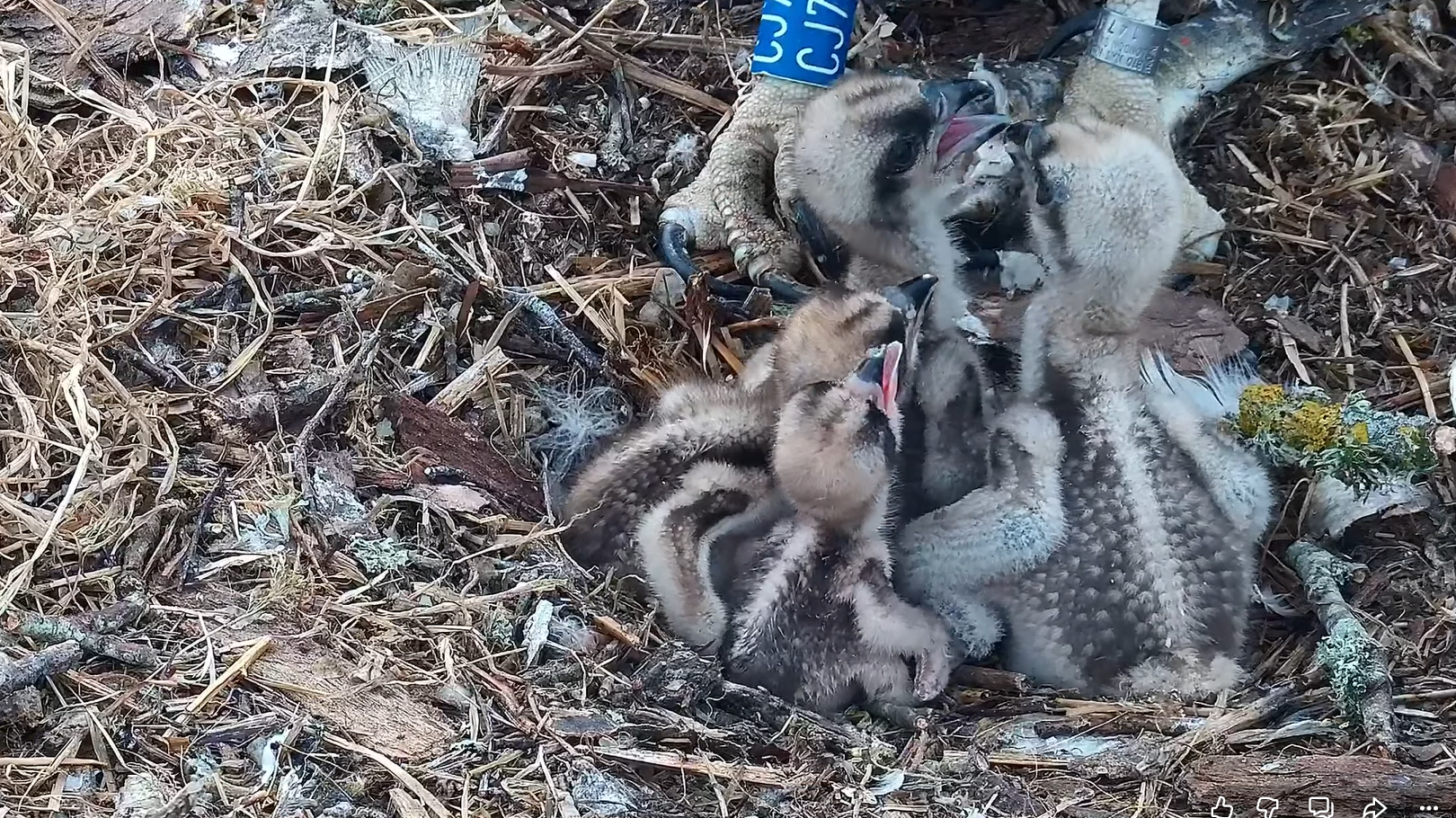
CJ7 feeding her four chicks on the Carey Nest
Diary Entry 23/04/26
It’s nearly a whole month since CJ7 and 022 arrived back on their nest! Since then, there’s been lots of action, with nest building, plenty of mating, intruders (!), and now 4 eggs. We’ve had interactions with other birds of prey, including a Red Kite mobbing 022 carrying a fish back onto the nest and both 022 and CJ7 seeing it off on the 18th April. CJ7 laid her first egg on the 14th April at 12:56pm, followed by a second on the 17th April at 08:48am, third on the 20th April at 08:26am, and fourth on 23rd April at 6:57am. The average incubation period is typically 37 days, so we should see hatching begin towards the end of May. CJ7 will do the majority of the incubation, although 022 will take his turn when CJ7 flies off to feed on a fish he’s brought back, or if she needs to stretch her wings!
We had an extremely exciting visit to the nest by an intruder Osprey, none other than CJ7 and 022’s young from 2024, male 5RO on the 21st April at 07:41am. Two year-olds typically arrive back later than breeding adults from May onwards, so the fact that 5R0 is back this early is interesting! Male Ospreys display a behaviour called natal philopatry, which means they are drawn to come back to their natal ground, where they fledged as a youngster. 5R0 was first seen in Devon on the Axe Estuary on the 17th April, before intruding on the Carey nest and being seen off quickly by his parents! We hope that 5RO will stick around, set up his own territory, and breed in the next couple of years.
You might also like...
Harbour Update – 20/10/26
Hard going today with non-stop rain since first light! The only report today was of 27 Spoonbill in…
Find out moreHarbour Update – 19/10/26
With both Long-tailed Duck and Velvet Scoter having passed Portland and Kimmeridge Bay in the last 48 hours,…
Find out moreCall 01202 641 003
© 2026 Birds of Poole Harbour Registered Charity No. 1152615