
Birds of Poole Harbour’s first ever peer-reviewed paper is published today in the Journal of Animal Ecology, looking at the long-term recovery of Ospreys in Scotland in collaboration with Bournemouth University and the Roy Dennis Wildlife Foundation!
Many of our supporters will know that our Species Recovery Coordinator, Brittany, has been studying for her PhD part-time alongside her work for the charity since 2019, funded by Birds of Poole Harbour thanks to a generous donation from our founders Mark and Mo Constantine. In July this year Brittany handed in her thesis and we’re delighted to see her first analysis chapter published today in the Journal of Animal Ecology. The paper is co-authored by her supervisors from Bournemouth University, Prof Richard Stillman, Dr Pippa Gillingham, and Prof Ross Hill, alongside Dr Tim Mackrill and Dr Roy Dennis OBE from the Roy Dennis Wildlife Foundation.
A female Osprey delivering nest material to one of the study nests on the Balavil Estate in the late 1980’s – Hugh Miles
Brittany’s PhD resea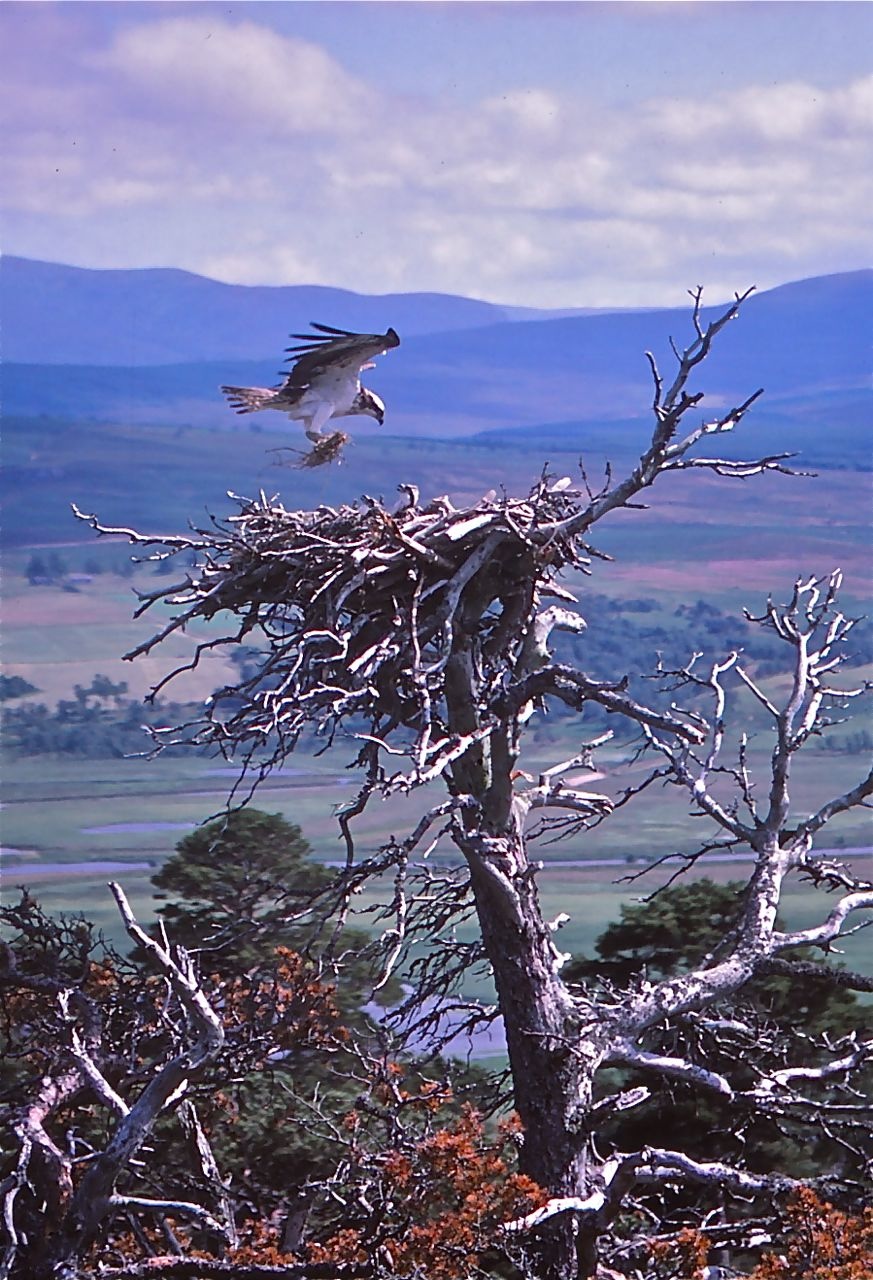 rch looked at the spatial dynamics of the Northern Scotland Osprey population during recolonisation, using the remarkable long-term data which was collected over 54 years between 1954 and 2007 by the Roy Dennis Wildlife Foundation. This first study reveals that faster recovery of Osprey populations relies heavily on a small number of Ospreys who, unlike most, prefer to nest away from others of the same species. We refer to these birds as ‘pioneering pairs’ and they could be the secret to helping accelerate population expansion.
Brittany said: “Ospreys usually like to nest in areas where there are already other Ospreys, which we refer to as conspecific attraction. Most males also exhibit natal philopatry, which means they tend to breed close to their own birthplace. Together, these factors lead to very slow population spread for such a large bird. However, in Scotland we noticed that a small number of pairs were choosing to settle more than 20 km away from all the others, in areas with no competition. We call these ‘pioneering pairs’ as they recolonise new areas, and in doing so create separate subpopulations and increase the speed of recovery for the species.”
Restoring lost species is a key goal in conservation, but very little is known about the process of recolonisation. The study found that the patterns seen in Ospreys are very similar to other types of population expansion which have been much better studied, like biological invasions. The tools that scientists use to investigate these species could therefore also be used to better understand and help recovering species.
The paper’s findings also point to other potential solutions to speed up the recovery of Osprey populations. Dr Tim Mackrill, Lead Ornithologist at the Roy Dennis Wildlife Foundation said: “This study highlights how much the spatial expansion of Ospreys relies on the long-distance dispersal of these rare pioneering individuals. It suggests that the best way to accelerate natural recovery rates is for conservationists to encourage or even replicate these pioneering movements. We can do this by building artificial nests to help entice Ospreys into new areas or by physically moving individuals via translocation.”
Ospreys once bred across much of Britain, but by 1916 they had disappeared due to hunting and egg collecting. However, after a pair naturally returned to a nest site at Loch Garten in Scotland in 1954, a conservation movement began to protect nesting pairs and help the species recover. Dr Roy Dennis OBE, founder of the Roy Dennis Wildlife Foundation has been monitoring and conserving the Scottish population since the 1960s, leading to the incredible dataset behind this study. Roy said: “It’s fantastic that this dataset, which we’ve collected over many decades, continues to teach us more about these remarkable birds. Our findings reinforce that we’re taking the right approach to restore Ospreys across the UK and beyond, and suggest that we should be using these measures even more widely to see faster recovery of the species across Europe.”
One of the translocated Osprey chicks in the hacking cages during the Poole Harbour Translocation Project
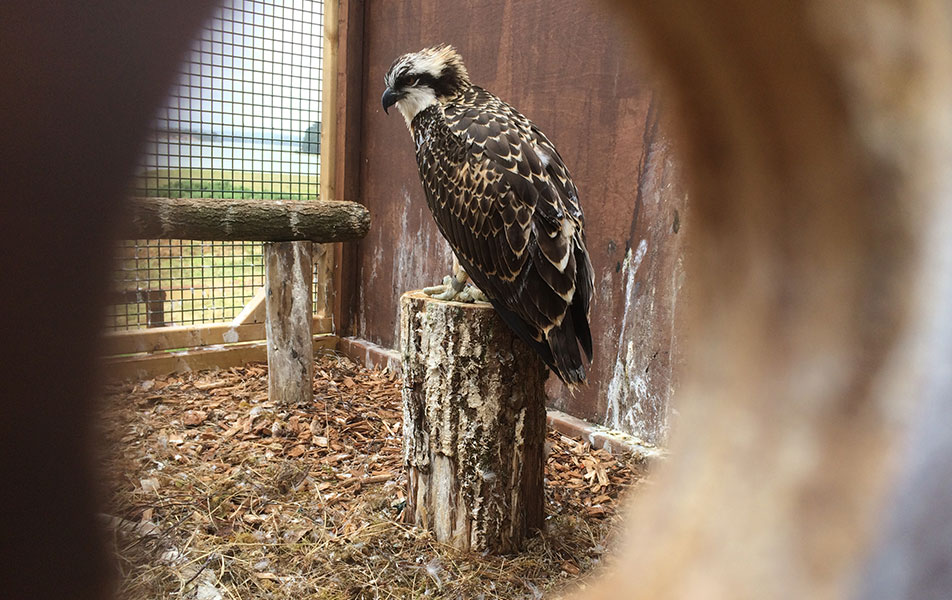 An excellent example of where these techniques have already helped Ospreys recover is here in Poole Harbour, with the five-year translocation project which we ran from 2017-2021 in collaboration with the Roy Dennis Wildlife Foundation, moving young Ospreys from Northern Scotland to Poole Harbour. Healthy chicks were taken from longstanding nests at 7 weeks old and moved temporarily to hacking cages here in Dorset to finish developing before being released into the surrounding landscape, which they quickly came to recognise as home. Brittany said: “Through translocation we can essentially create our own pioneering birds to kickstart a new population! The first breeding pair in Poole Harbour was a male named 022 who we had translocated from Scotland, and a female named CJ7 who had visited from a population 200 km away and was attracted to stay by the presence of translocated chicks. In 2022 they hatched two chicks of their own, becoming the first breeding Ospreys in Southern England since 1847. If it wasn’t for the translocation project, we may have had to wait another 60 years for breeding Ospreys to reach Dorset naturally!”
The project has been a huge success story, with CJ7 and 022 returning to breed and producing chicks at the same nest each year since. This summer they have hatched a staggering four chicks for the third year in a row, all of which are still currently in the harbour, with a chance of being seen from our upcoming Osprey Cruises. And several pioneering movements have also been recorded, with a second pair breeding away from the harbour and the first wild born Poole Harbour chick now breeding in the East Midlands. Both pairs are forming new subpopulations and starting to close the gap between Poole Harbour and the nearest Osprey population in Rutland Water.
Brittany adds: “Translocation is an incredible tool, but it can take many years to see the results. We’re still in the early stages in Dorset, but are already seeing some of the first wild born chicks returning, with four eligible young males currently exploring suitable nest sites and looking for mates. We hope that in the coming years some of them will become pioneers themselves, helping the population spread along the south coast of England. Artificial nests have already been built for them in neighbouring counties like Devon and Hampshire, and based on the results of our study we’ll be aiming to provide lots more.”
We hope that this research will help motivate more conservation action for Ospreys across Europe, where they are still missing from much of their historical range. Brittany and her co-authors also have plenty more research questions which they plan to investigate next, such as what determines where Ospreys choose to nest and what makes pioneering pairs different. And from August, Brittany will be returning to working full time for Birds of Poole Harbour as our Chief Species Recovery and Scientific Lead.
You can read the full paper for free here.
If you’d like to help us continue connecting more people with Ospreys and building artificial nests along the south coast to encourage their spread into new areas in Dorset and beyond, then please consider donating to our Osprey Project fundraiser. Thank you!
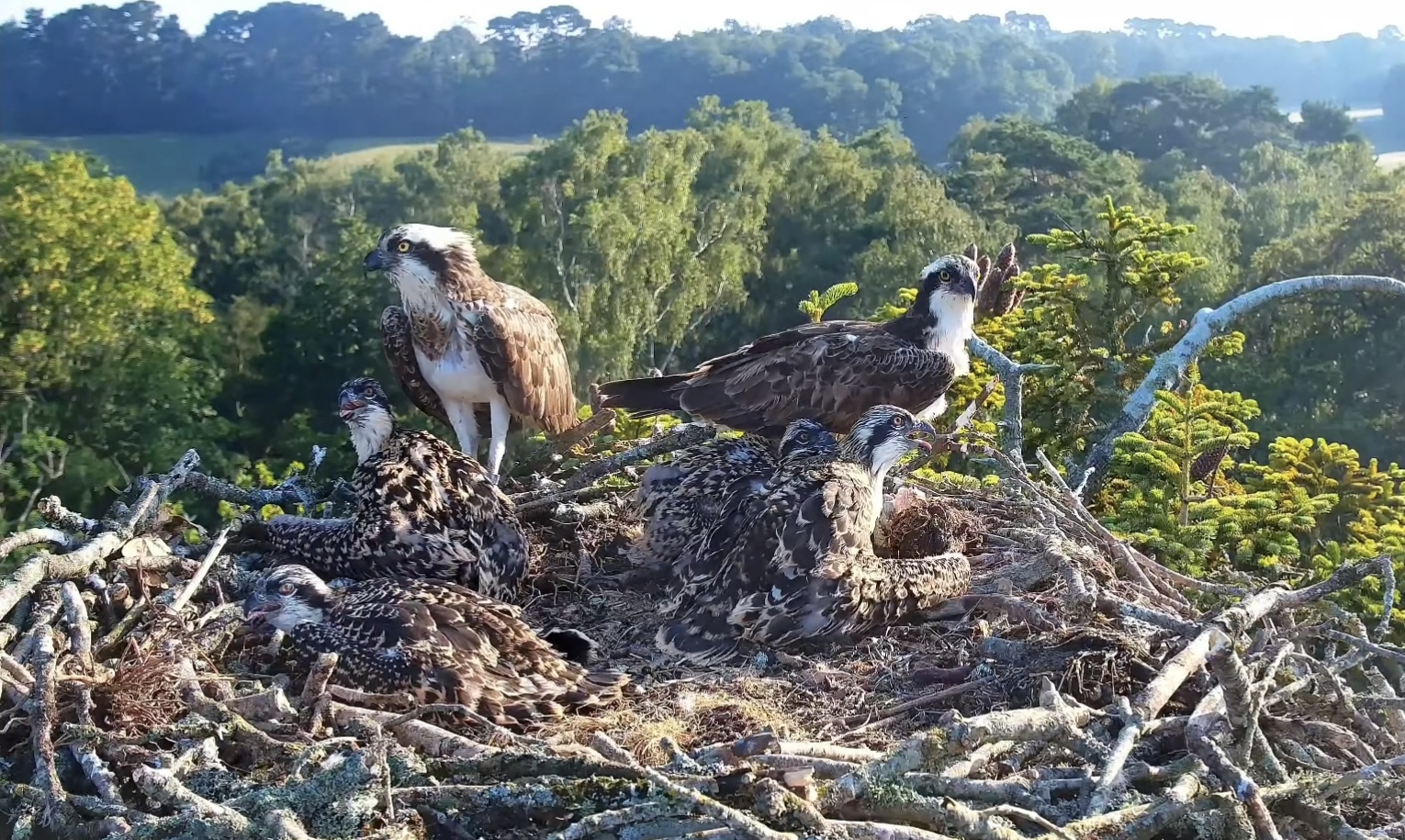
Poole Harbour’s own pioneering pair: CJ7, 022 and their four chicks at the Carey Nest this year
You might also like...
Harbour Update – 13/10/26
A much finer day when all of the gloom cleared at exactly 10am. The Brownsea Lagoon was busy…
Find out moreHarbour Update – 12/10/26
Based on how much we could see from the quay for most of the day, it was probably…
Find out more
Call 01202 641 003
© 2026 Birds of Poole Harbour Registered Charity No. 1152615